
If you’re still paying a premium for a satellite dish on your roof, you might be funding a dinosaur.
The story of television used to be simple: big dishes, long cables, and expensive contracts. But the industry has shifted beneath our feet. We are witnessing the end of the “brute force” era of broadcasting and the dawn of the precision era.
At tvcrystal, we’ve tracked this shift from day one. This isn’t just a change in technology; it’s a fundamental upgrade to how you consume media. In this guide, we break down why the Satellite vs. IPTV war is already over, and why your internet connection is the only antenna you’ll ever need.
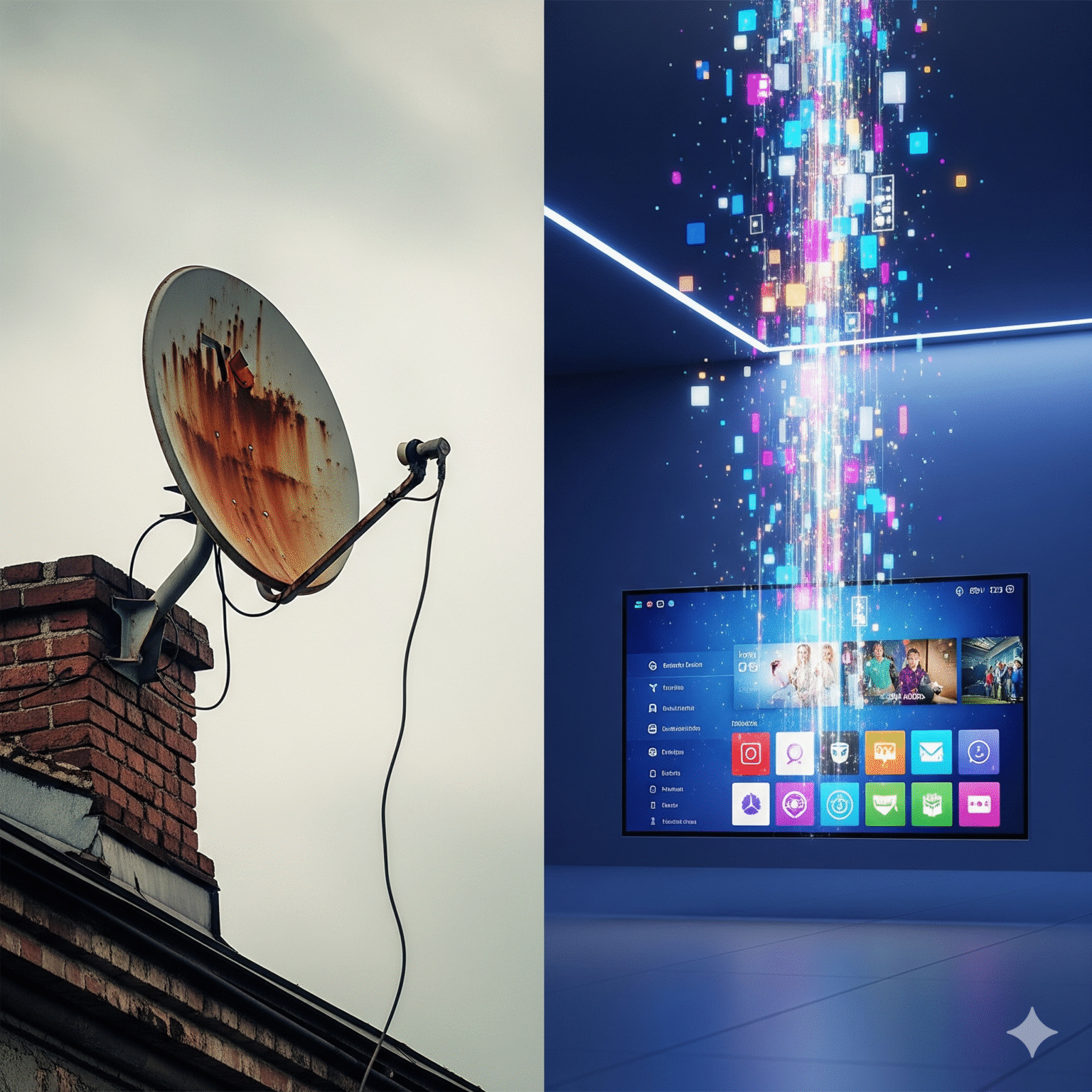
1. The Legacy Era: Why Satellite (DTH) Ruled the World
Before fiber optics crisscrossed the globe, the only way to get TV to remote locations was to beam it from space. Direct-to-Home (DTH) satellite was a marvel of engineering, but today, it’s showing its age.
The Engineering Feat (and Flaw)
Satellite TV works on a Geostationary Earth Orbit (GEO) architecture.
The Uplink: Broadcasters beam signals 35,786 km into space.
The Downlink: The satellite bounces it back to your dish.
The Problem? Physics. We call it the “Rain Fade.” Because DTH relies on high-frequency radio waves (Ku/Ka-band), a heavy storm can literally wash away your signal. Plus, the 72,000 km round trip creates latency. Ever hear your neighbor cheer for a touchdown 10 seconds before you see it? That’s the speed of light slowing you down.
2. The Solution: How IPTV Changed the Game
Internetprotokoll-tv (IPTV) is the answer to the limitations of physics. Unlike Netflix (which is “OTT” or Over-The-Top), true IPTV runs on managed networks optimized for speed and quality.
Why Packets Beat Frequencies
Here is the secret sauce: Switched Video.
Satellite Model: Every channel hits your house at once. It’s inefficient.
IPTV Model: You only get what you ask for.
When you click a channel on an IPTV box, you send an IGMP (Internet Group Management Protocol) request. The network instantly switches your specific stream. This frees up massive bandwidth for things that actually matter like 4K resolution och zero buffring.
Tech Breakdown: Multicast vs. Unicast
Live TV (Multicast): One stream serves millions. It’s efficient and keeps your internet bill lower.
On-Demand (Unicast): A dedicated line just for you. This enables the magic of “Restart TV” and “Inhämtning” features that satellite simply can’t match without expensive hardware.
3. Head-to-Head: Satellite vs. IPTV
We’ve compared the two technologies to show you exactly what you’re paying for.
Funktion | Satellite TV (Legacy) | IPTV (Modern Standard) | Vinnare |
|---|---|---|---|
Transmission | RF Signals via Space | Data Packets via Fiber | IPTV |
Tillförlitlighet | Vulnerable to Weather | Consistent (Hardwired) | IPTV |
Interaktivitet | Passive (One-way) | Active (Two-way) | IPTV |
Latency | High (Satellite Delay) | Low (Instant) | IPTV |
Kostnad | High Infrastructure Costs | Scalable & Lower Cost | IPTV |
4. The Market Reality: The Great Cord-Cutting of 2026
The data doesn’t lie. The shift isn’t coming; it’s here.
In December 2025, a historic milestone was crossed: Streaming platforms captured 47.5% of all U.S. TV viewing, officially surpassing broadcast and cable combined.
The “Cord-Nevers”: Over 50% of adults under 32 have never paid for a cable subscription. They live entirely in the app ecosystem.
The Decline: Global satellite markets are shrinking by -1.2% annually. Even giants like Sky in Europe are stopping dish installations in favor of their IP-based “Sky Stream” pucks.
The verdict? If you are investing in new satellite hardware today, you are buying obsolete tech.
5. What’s Next? The All-IP Future (2030 Vision)
We predict that by 2030, the massive satellite fleets orbiting Earth will begin their final “sunset.” Broadcasters are stopping the replacement of aging satellites. The capital is moving to Content Delivery Networks (CDN) och 5G Broadcast.
The Final Nail: Low-Latency Streaming
The only advantage satellite held was live sports speed. But with new protocols like LL-HLS och WebRTC, streaming latency is dropping below 2 seconds. The delay is gone.
Conclusion: Make the Switch
The evolution from Satellite to IPTV is the digitization of the last analog stronghold in your home. It’s a shift from a “uninformed” one-way broadcast to a smart, interactive experience.
Are you ready to future-proof your entertainment? Stop paying for the infrastructure of the past. The future is packet-switched, high-definition, and on-demand.
 Swedish
  English (United States)
  German
  Dutch
Dutch  Danish
  English (UK)
  English (Australia)
  English (New Zealand)
  Norwegian