
If you are paying for an IPTV-tjänst, you already know the massive value it brings thousands of live channels, vast video-on-demand libraries, and premium sports coverage for a fraction of traditional cable costs. But as the streaming landscape shifts, so does the level of scrutiny from Internet Service Providers (Internetleverantörer).
The most common question new subscribers ask is: Do I really need a VPN for IPTV?
Det korta svaret är yes. Whether you stream via a smart TV, Firestick, or dedicated Android box, running an IPTV connection without a Virtual Private Network (VPN) leaves your setup exposed to artificial speed drops, privacy breaches, and regional content blocks.
Here is the technical breakdown of why a VPN is no longer optional for a buffer-free home theater experience.
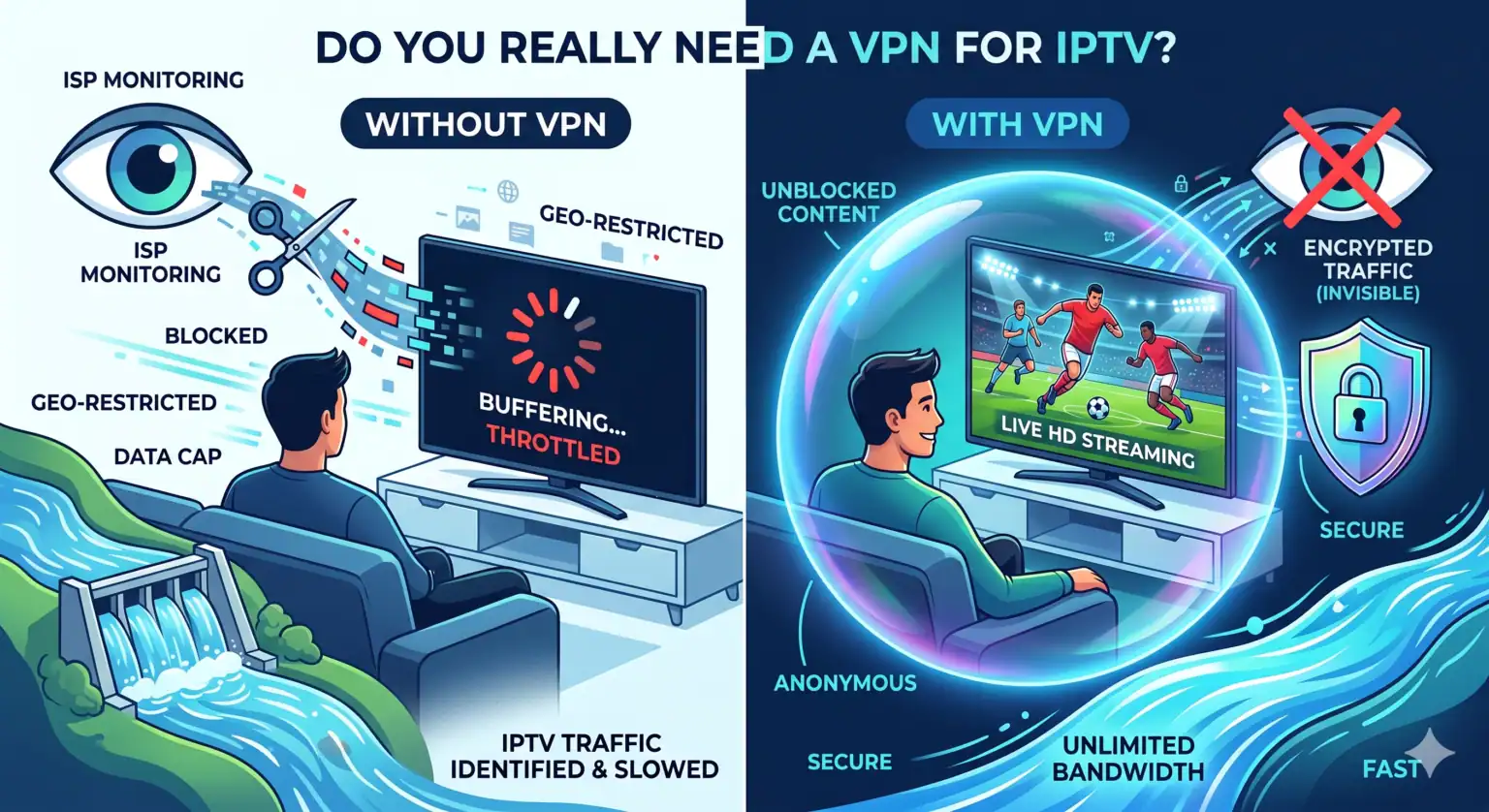
1. Stopping ISP Throttling and Constant Buffering
The biggest misconception in streaming is that buffering is always the provider’s fault. While overloaded servers can cause lag, the primary culprit is often your own ISP.
ISPs utilize Deep Packet Inspection (DPI) to monitor your internet traffic in real time. When they detect heavy bandwidth consumption like continuous 4K-streaming during peak evening hours or major live sports events they intentionally throttle your download speeds to manage network congestion.
How a VPN fixes this:
A VPN routes your traffic through an encrypted tunnel. Your ISP only sees encrypted data flowing to a single secure server; they cannot see vad you are doing. Because they cannot identify the video traffic, they cannot selectively throttle it. If your stream stutters at 8 PM but clears up the moment a VPN is activated, Strypning av internetleverantör is the exact cause.
2. Protecting Your Privacy and Anonymity
Connecting to a portal without a VPN leaves your raw IP address visible to the host, your ISP, and potential third-party trackers.
Even when using a fully verified service, your ISP logs your streaming habits, which can be used to enforce data caps or be sold to advertisers. A VPN masks your real IP address and replaces it with the IP of the secure server. This creates an anonymous streaming environment, ensuring your viewing habits and device data remain strictly your business.
3. Bypassing Regional Blackouts and Geo-Blocks
Sports fans are all too familiar with the frustration of regional blackouts. Local networks frequently secure exclusive broadcast rights to specific games, forcing providers to block the stream in certain regions or countries.
With a VPN, you are not locked into your physical location. If a Premier League match or UFC fight is blocked in your immediate area, you can easily switch your VPN server to a different country and access the broadcast instantly. Global server access ensures you get the full value out of your channel list, regardless of where you live.
4. Securing Mobile and Public Wi-Fi Streams
If you travel and watch TV on hotel Wi-Fi, airport networks, or cafes using a smartphone or laptop, you are streaming on an unsecured network. Malicious actors routinely monitor public Wi-Fi to intercept user data. Activating a VPN ensures that even on an open network, your connection is heavily encrypted (typically with AES-256) and safe from interception.
Free vs. Premium VPNs: Why Cutting Corners Fails
It is tempting to install a free VPN, but for high-definition streaming, this is a mistake that will ruin your setup.
Bandwidth Limits: Free applications frequently cap your data. Streaming high-definition video will burn through a free monthly allowance in a matter of hours.
Speed Drops: Unpaid servers are inherently overcrowded, resulting in the exact latency and buffering issues you are trying to avoid.
Weak Encryption: Many free services lack the technical infrastructure to actually hide your packets from your ISP.
For seamless playback, you need a premium VPN with unlimited bandwidth, a strict zero-logs policy, and optimized infrastructure. Look for providers utilizing the WireGuard protocol, which is currently the industry standard for maintaining maximum speeds with minimal overhead.
Det slutliga utlåtandet
Can you run your service without a VPN? Technically, yes. Should you? Absolutely not.
Between artificial speed throttling, privacy vulnerabilities, and geo-restrictions, an unprotected connection severely limits hardware performance. Pairing your subscription with a high-quality VPN is the only proven method to guarantee a secure, fast, and consistently reliable viewing experience.
 Swedish
  English (United States)
  German
  Dutch
Dutch  Danish
  English (UK)
  Norwegian