
Stop me if this sounds familiar: You hear your neighbor scream “GOAL!” through the wall, but on your screen, the striker hasn’t even touched the ball yet.
In the analog age, the speed limit was the speed of light. In the digital streaming era, we introduced a new problem: latency. For live sports, this gap the delay between reality and your retina is no longer just an annoyance. It is the single biggest engineering bottleneck in the media industry.
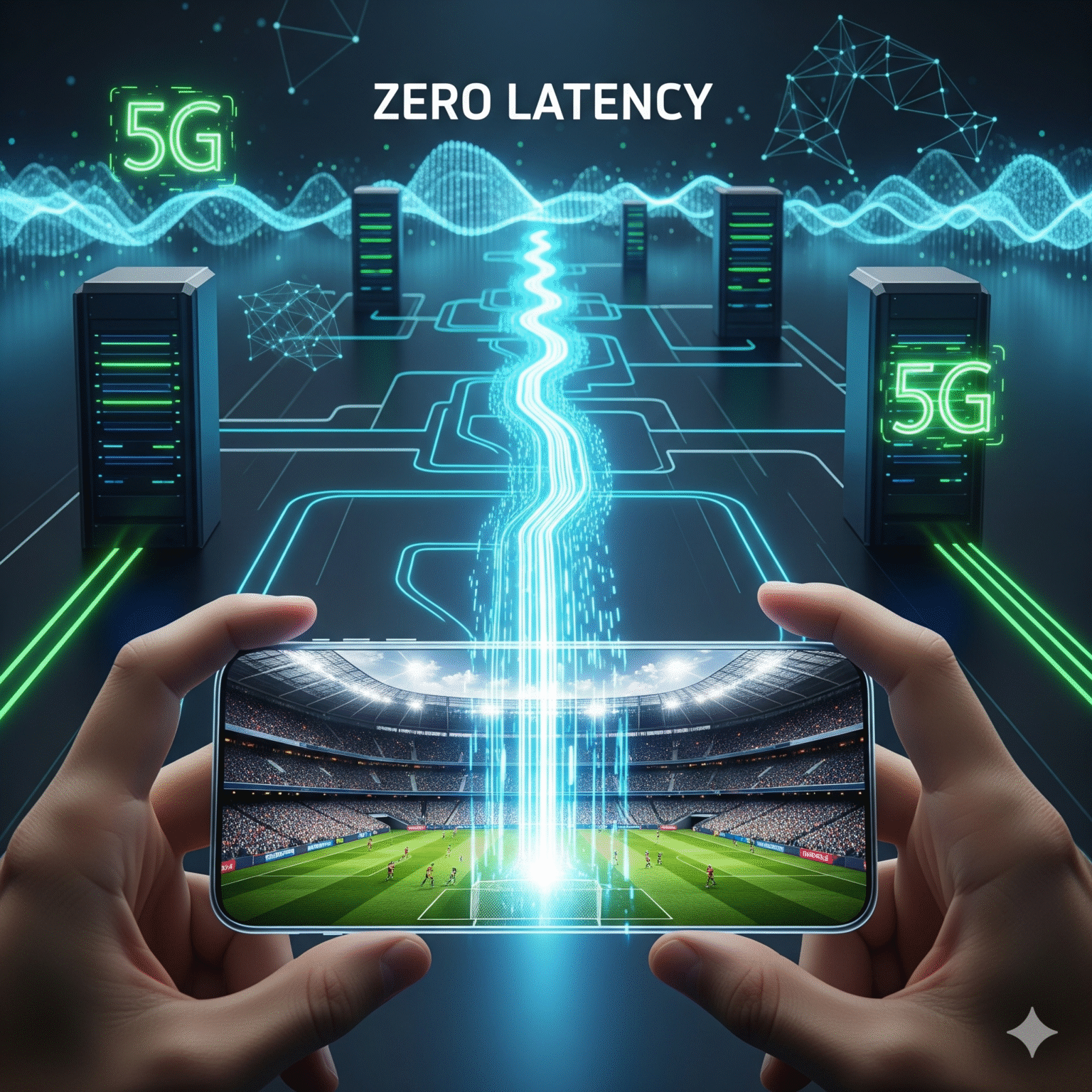
The stakes have evolved. It’s not just about spoilers anymore; it’s about money. The explosion of in-play micro-betting, interactive watch parties, and second-screen experiences has monetized the millisecond. In this deep dive, we break down the race to “Zero Latency”, analyzing the protocols (WebRTC vs. HLS), the infrastructure (Edge Computing), and the massive financial incentives reshaping how we watch sport in 2026.
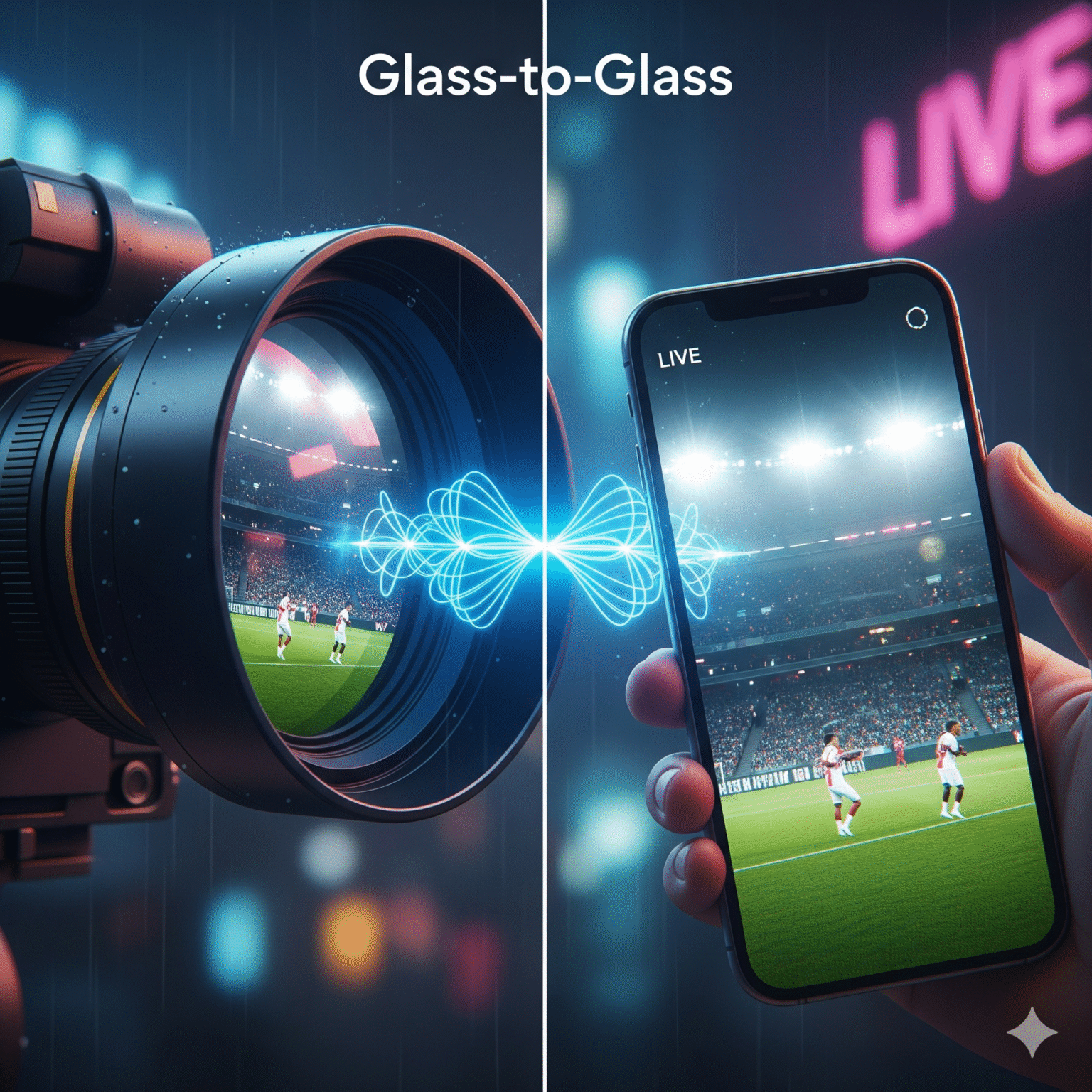
1. The Latency Gap: What is "Glass-to-Glass"?
To solve the problem, we first have to measure it. In the industry, we call this Glass-to-Glass latency. It measures the milliseconds that tick by from the moment photons hit the camera lens at the stadium to the moment they hit the viewer’s screen.
If you aren’t optimizing for this, you’re already behind. Here is the hierarchy of delay:
Tier | Latency | The User Experience | The Technology |
|---|---|---|---|
Standard Streaming | 20–45s | The “Spoiler Zone.” Viewers see the score on Twitter/X before it happens on TV. High churn risk. | Legacy HLS / DASH |
Broadcast TV | 6–10s | The Old Benchmark. Reliable, high quality, but fundamentally aging technology. | Kabel / Satelliet |
Low Latency | 2–5s | Broadcast Parity. The current standard for premium OTT apps (Apple TV, Peacock, etc.). | LL-HLS, LL-DASH (CMAF) |
Real-Time | < 500ms | The Holy Grail. Required for betting, gamification, and true interactivity. | WebRTC, WebSocket |
2. The Protocol Wars: Chunked vs. Continuous Delivery
The engineering race is currently defined by a battle between two distinct architectural philosophies: Segmented HTTP Delivery vs. Real-Time Transport. Which one should you bet on?
A. The Incumbent: LL-HLS and Low-Latency DASH
Traditional streaming works by slicing video into 6–10 second “chunks.” The player downloads a few chunks to build a buffer before playing. It’s stable, but slow.
The Upgrade: Ga naar CMAF (Common Media Application Format) and “Chunked Transfer Encoding.” Instead of waiting for a full 6-second segment to encode, the server pushes tiny “micro-chunks” (e.g., 200ms) to the player the instant they are ready.
Why it Wins: Scalability. It leverages existing Content Delivery Networks (CDN's) cheaply.
Why it Fails: It has a hard latency floor of ~2-3 seconds. TCP retransmission means if your internet hiccups, you enter a bufferend spiral.
B. The Challenger: WebRTC (Web Real-Time Communication)
Originally built for Zoom calls and Google Meet, WebRTC is being weaponized for broadcast.
The Disruption: It uses UDP (User Datagram Protocol). Unlike TCP, UDP doesn’t stop to ask “Did you get that packet?” It prioritizes speed over perfection. If a packet drops, you get a micro-glitch, not a frozen screen.
Why it Wins: True sub-second latency (<500ms). This enables real-time synchronization between video and data overlays.
De vangst: Cost & Scaling. WebRTC doesn’t cache like a standard file. It requires a stateful connection for every single viewer.
The Fix: Hybrid solutions (Red5 Pro, Phenix, Dolby.io) are now ingesting via SRT and delivering via custom WebRTC-CDN hybrids to solve the scaling issue.
3. Follow the Money: The Micro-Betting Imperative
Why spend millions shaving off seconds? Because latency is arbitrage.
Sportsbooks are aggressively moving toward Micro-Betting wagers on instantaneous outcomes (e.g., “Will this specific free throw go in?”). This market cannot exist with a 10-second delay.
The “Courtsiding” Risk: If your stream is 10 seconds behind, a fan at the stadium knows the outcome before the bookmaker’s algorithm locks the bet. They can place a winning wager on an event that has already happened.
The ID3 Tag Solution: To combat this, platforms are synchronizing ID3 tags (metadata hidden in the video stream) with the betting API. This ensures the “Bet Now” button locks the exact millisecond the ball leaves the player’s hands, regardless of video lag.
4. The Final Frontier: Edge Computing & 5G
Even with the perfect protocol, the “last mile” (the ISP connection to your house) is a bottleneck. This is where infrastructure saves the day.
5G Network Slicing
We are seeing the rollout of URLLC (Ultra-Reliable Low-Latency Communications). Telecoms are testing “Network Slicing,” essentially carving out a VIP lane on the 5G highway specifically for live sports data, bypassing neighborhood traffic jams.
Rendering at the Edge
Why process video in a data center in Virginia if the viewer is in London? Edge Computing moves the heavy lifting:
Ingest: Video enters the network at the closest local Point of Presence (PoP).
Process: Transcoding and packaging happen locally.
Deliver: The stream travels miles, not continents, to reach the end user.
5. Conclusion: The Hybrid Future
So, who wins the race?
For massive events like the Super Bowl, LL-HLS (2-4s latency) is the victor. It is safe, cost-effective, and scales to 100 million concurrent viewers without breaking the bank.
But for the premium, high-value user the bettor, the interactive fan, the “Watch Party” host WebRTC is the standard. We predict a tiered future for sports streaming:
The Free Tier: Standard broadcast latency (4s delay).
The Premium Tier: “Pro” access with real-time delivery (200ms delay) and integrated betting.
The technology to beat broadcast TV already exists. The only remaining hurdle is the economics of bandwidth.
 Dutch
Dutch  English (United States)
  German
  Swedish
  Danish
  English (UK)
  English (Australia)
  English (New Zealand)
  Norwegian