
De juiste keuze maken IPTV-streaming kwaliteit can completely change your viewing experience. One of the most common questions users search for in 2026 is:
What’s the difference between HD, Full HD, and 4K IPTV and which resolution is best for my setup?
Dit IPTV quality guide explains the real-world differences between HD IPTV, Full HD IPTV, and 4K IPTV, helping you select the best resolution based on internet speed, device type, and viewing habits.
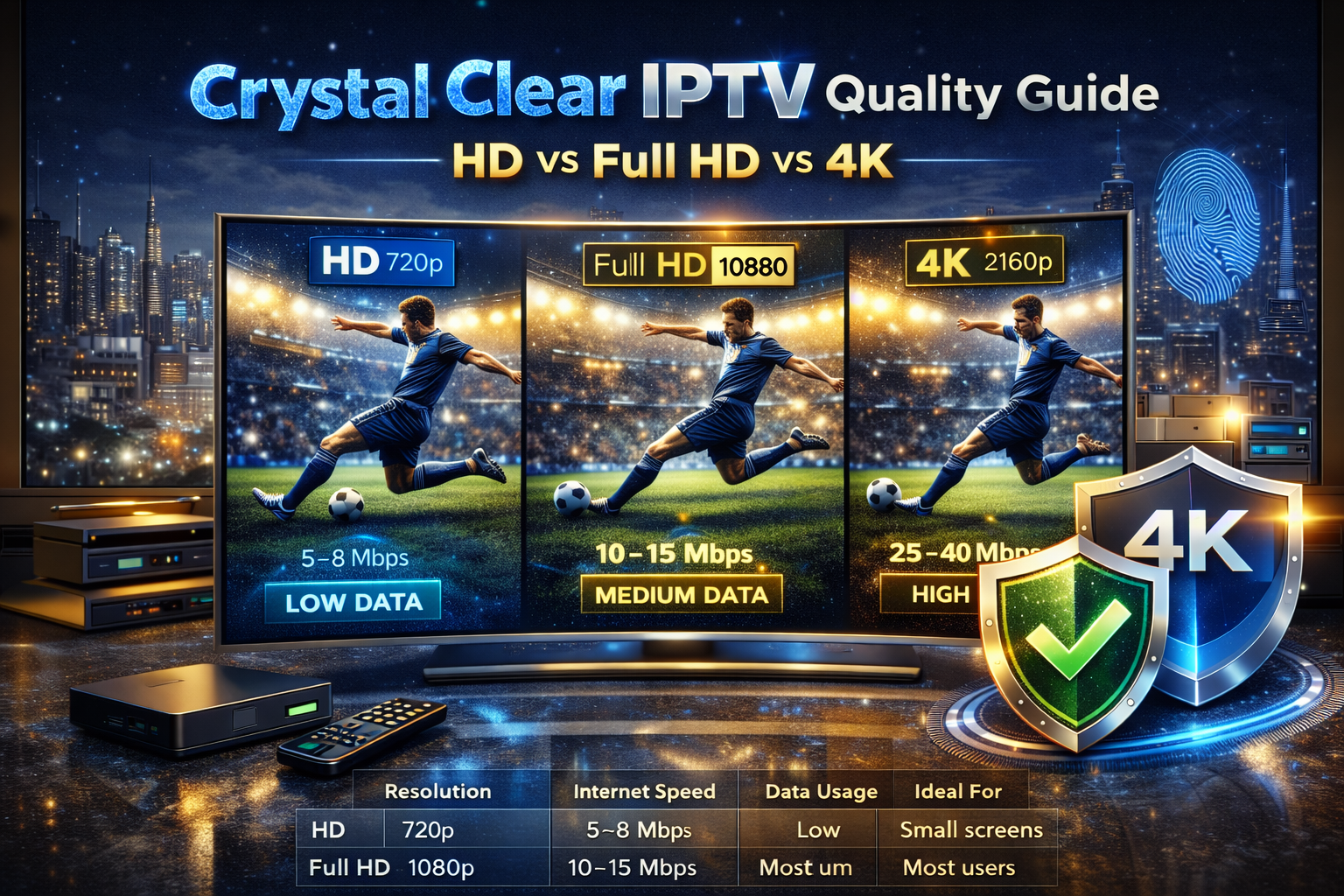
What Really Affects IPTV Picture Quality?
IPTV quality is not just about resolution. Several technical factors work together to determine how clear and smooth your stream looks:
Video resolution (HD, Full HD, 4K)
Bitrate and compression technology
Internet speed and stability
Smart TV or streaming device performance
IPTV server infrastructure
Premium services like Kristal IPTV optimize these elements to deliver crystal-clear IPTV quality with minimal buffering, Zelfs tijdens piekuren.
HD IPTV Quality (720p) – Stable & Efficient
Wat is HD IPTV?
HD IPTV streams at 1280 × 720 pixels (720p) and remains widely used due to its low bandwidth requirements.
Best Use Cases
Older Smart TVs
Smaller screens
Slower or unstable internet connections
Mobile devices
Technical Requirements
Recommended speed: 5–8 Mbps
Stable connection over Wi-Fi or Ethernet
Voordelen
✔ Low data consumption
✔ Fast channel loading
✔ Very stable playback
Beperkingen
✖ Less sharp on large TVs
✖ Limited detail for sports and movies
Full HD IPTV Quality (1080p) – The Best Balance
What Is Full HD IPTV?
Full HD IPTV streams at 1920 × 1080 pixels (1080p) and is the most popular IPTV resolution in 2026.
Best Use Cases
Modern Smart TVs
Live sports and movies
Daily home entertainment
Technical Requirements
Recommended speed: 10-15 Mbps
Stable Wi-Fi or wired connection
Voordelen
✔ Sharp, detailed picture
✔ Smooth motion for sports
✔ Balanced data usage
Beperkingen
✖ Requires better internet than HD
4K IPTV Quality (Ultra HD) – Premium Streaming
What Is 4K IPTV?
4K IPTV streams at 3840 × 2160 pixels, delivering four times the detail of Full HD.
Best Use Cases
Large 4K Smart TVs
Home cinema setups
Premium sports and movie content
Technical Requirements
Recommended speed: 25-40 Mbps
Wired Ethernet strongly recommended
High-performance IPTV-servers
Voordelen
✔ Ultra-sharp image clarity
✔ Superior color depth and detail
✔ Best viewing experience on large screens
Beperkingen
✖ High data usage
✖ Sensitive to unstable internet
✖ Limited 4K channel availability
HD vs Full HD vs 4K IPTV – Quick Comparison Table
| Functie | HD (720p) | Full HD (1080p) | 4K (2160p) |
|---|---|---|---|
| Resolutie | 1280×720 | 1920×1080 | 3840×2160 |
| Visual Quality | Basis | Very Sharp | Ultra-Detailed |
| Internet Speed | 5–8 Mbps | 10-15 Mbps | 25-40 Mbps |
| Data Usage | Laag | Gemiddeld | Hoog |
| Ideal For | Small screens | Most users | Home cinema |
Which IPTV Resolution Should You Choose?
Choose HD IPTV if:
Your internet speed is limited
You want maximum stability
You use older TVs or small screens
Choose Full HD IPTV if:
You want the best balance of quality and performance
You watch sports and movies regularly
You own a modern Smart TV
Choose 4K IPTV if:
You have fast, stable internet
You own a 4K television
You want the highest possible image quality
Tips to Get Crystal-Clear IPTV Quality
✔ Use a wired Ethernet connection
✔ Avoid congested Wi-Fi networks
✔ Select servers closest to your location
✔ Use high-quality IPTV players
✔ Keep Smart TV firmware updated
These steps significantly improve IPTV streaming quality and stability.
Final Verdict: Best IPTV Quality in 2026
There is no universal “best” IPTV resolution the right choice depends on your setup.
HD IPTV offers stability and efficiency
Full HD IPTV delivers the best overall experience
4K IPTV provides premium quality for advanced setups
For most users in 2026, Full HD IPTV remains the ideal choice, while 4K IPTV is perfect for users with fast internet and high-end TVs.
 Dutch
Dutch  English (United States)
  German
  Swedish
  Danish
  English (UK)
  English (Australia)
  English (New Zealand)
  Norwegian