
Wenn man sich hinsetzt, drückt man eine Taste auf der Fernbedienung, und ein klarer 4K-Stream Sobald das Bild erscheint, entfaltet sich hinter der Glasscheibe ein perfekt abgestimmtes Netzwerk-Ballett. Jahrzehntelang stützte sich der traditionelle Rundfunk auf Satellitenschüsseln und Koaxialkabel, um identische Hochfrequenzsignale in jeden Haushalt der Nachbarschaft zu übertragen. Heute sind Videos Daten.
Um diese Daten nahtlos zu übertragen, ist ein komplexes Zusammenspiel aus Netzwerktechnik, aktiver Bandbreitenoptimierung und intensiver Komprimierung erforderlich.
Ganz gleich, ob Sie eine Streaming-Plattform oder Optimierungstools entwickeln oder die Netzwerkinfrastruktur bewerten – ein Verständnis der Funktionsweise der modernen Videoverteilung ist unerlässlich. Dieser Leitfaden erläutert die Architektur, die dem modernen Internet Protocol Television (IPTV), Over-the-Top (OTT) Plattformen sowie die zugrunde liegenden Protokolle, die eine reibungslose Wiedergabe ermöglichen.
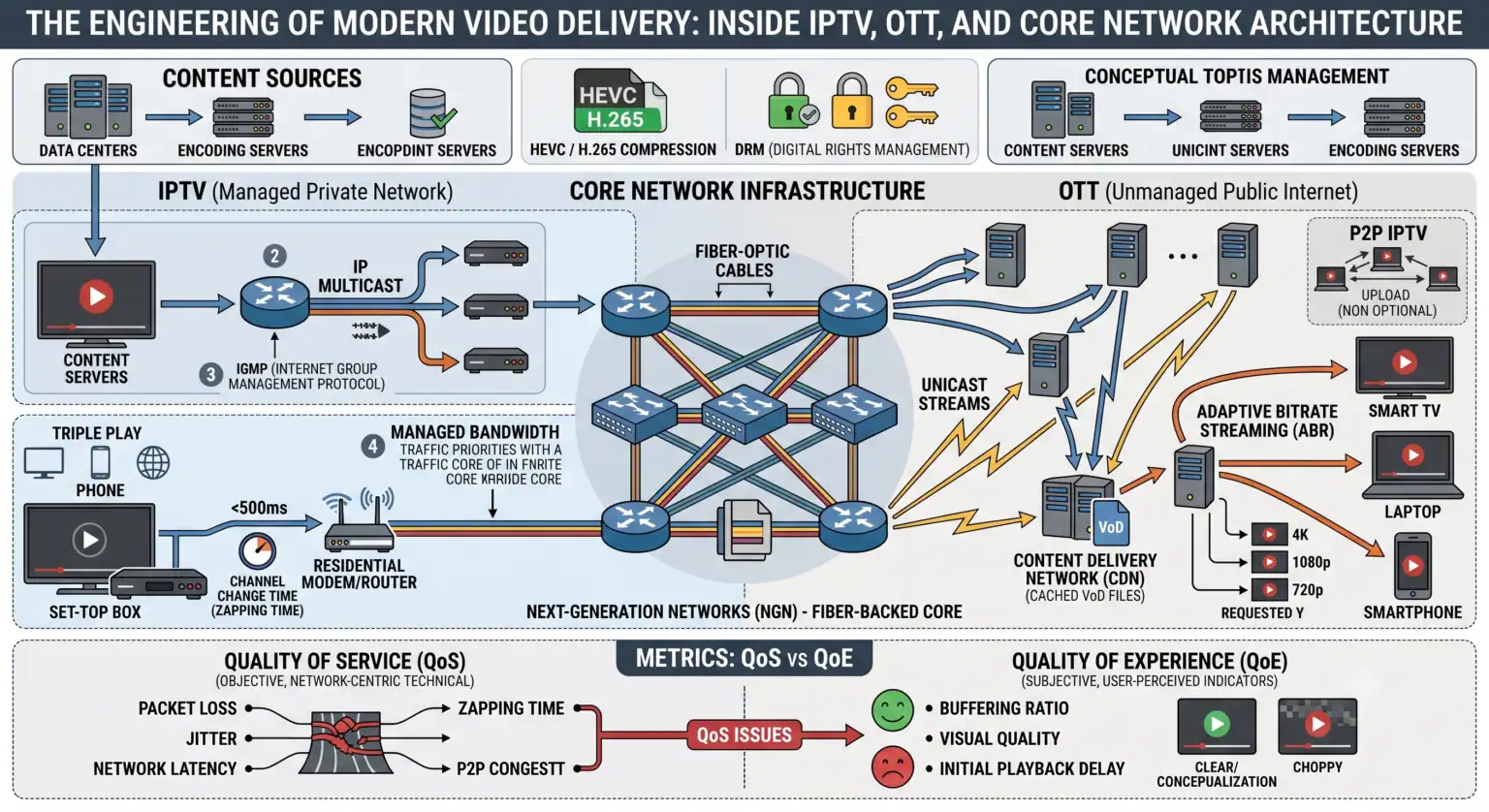
1. Verwaltete vs. nicht verwaltete Netzwerke: IPTV vs. OTT
Während normale Nutzer oft alle internetbasierten Videos in einen Topf werfen, ziehen Ingenieure eine klare Grenze zwischen IPTV und OTT. Der Unterschied liegt ausschließlich in den Eigentumsverhältnissen und der Kontrolle über den Übertragungsweg der Pakete.
+-------------------------------------------------------------------------+
| DER VIDEOPFAD |
+-------------------------------------------------------------------------+
| |
|  [IPTV] ---> Privates Kernnetzwerk ---> Edge-Switch ---> Set-Top-Box     |
| (Garantierte Bandbreite / RSVP / IGMP) |
| |
|  [OTT]  ---> Öffentliches Internet    ---> ISP-Knoten     ---> Endgerät    |
| (Best-Effort / Paketüberlastung) |
+-------------------------------------------------------------------------+
IPTV (Internet-Protokoll-Fernsehen)
IPTV wird über eine verwaltete, private Netzwerkinfrastruktur betrieben. Diese befindet sich in der Regel im Besitz eines Telekommunikationsanbieters oder Internetdienstanbieters (ISP). Da der Anbieter Eigentümer der Router, Switches und Glasfaserkabel ist, die vom Rechenzentrum direkt zum Haus des Nutzers führen, kann er die Prioritäten im Datenverkehr strikt durchsetzen.
IPTV wird üblicherweise als Teil eines Triple Play Ein Dienst, der Telefonie, Hochgeschwindigkeits-Breitband und Fernsehen über eine einzige physische Verbindung vereint. Dieses Ökosystem basiert auf Netzwerke der nächsten Generation (NGN), eine umfassende architektonische Umgestaltung, bei der ältere Telekommunikationssysteme auf konvergente, paketbasierte Netzwerke umgestellt werden. NGN bietet Netzbetreibern die erforderliche Feinsteuerung, um feste Bandbreitenblöcke ausschließlich für den Videoverkehr zu reservieren, sodass ein gleichzeitig stattfindender umfangreicher Dateidownload im Haushalt nicht dazu führt, dass das Fernsehbild verpixelt oder ruckelt.
OTT (Over-the-Top)
OTT umgeht die Kontrolle des Internetdienstanbieters vollständig. Dienste wie Netflix, YouTube oder Disney+ verbreiten Medien über das öffentliche, nicht verwaltete Internet. Die Videopakete durchlaufen ein Flickwerk aus Netzwerken von Drittanbietern und konkurrieren dabei mit Web-Datenverkehr, Gaming-Daten und Cloud-Backups. Da der Inhaltsanbieter den Netzwerkpfad von Ende zu Ende nicht kontrollieren kann, OTT Architekturen müssen äußerst agil sein und sich dynamisch und in Echtzeit an Netzwerküberlastungen anpassen.
2. Umfang der Live-Übertragung: IP-Multicast und IGMP
Die gleichzeitige Übertragung eines Live-Sportereignisses an Millionen von Zuschauern ist ein Albtraum für das Netzwerk. Wenn man an jedes einzelne Gerät einen eigenen Videostream sendet, handelt es sich um ein Modell, das als Unicast Die Kerninfrastruktur des Netzes wird unter der schieren Datenlast zusammenbrechen.
Um dieses Problem für Live-IPTV zu lösen, setzen Netzwerkarchitekten Folgendes ein: IP-Multicast.
Anstatt dass ein zentraler Server einen 10-Mbps-Videostream 100.000 Mal für 100.000 Zuschauer repliziert (was eine riesige 1-Terabit-Leitung erfordern würde), sendet der Server genau eine in das Netzwerk einspeisen. Während dieser einzelne Datenstrom die Netzwerkarchitektur durchläuft, replizieren lokale Switches und Router die Pakete nur dann, wenn dies zur Versorgung nachgelagerter Zweige erforderlich ist.
                    [Live-IPTV-Encoder-Quelle]
 |
 (Einzelner Stream)
 |
 [Core-ISP-Router]
                           / \
 (repliziert)  / \  (repliziert)
 / \
 [Edge-Switch A] [Edge-Switch B]
 / \ / \
 Box 1 Box 2 Box 3 Box 4
Dieses dynamische Routing wird über IGMP (Internet Group Management Protocol).
Wenn ein Abonnent auf Kanal 5 umschaltet, sendet seine Set-Top-Box ein
IGMP-BeitrittNachricht an den lokalen Edge-Switch.Wenn der Switch Kanal 5 bereits für einen anderen Nachbarn nutzt, klont er einfach die vorhandenen Pakete und leitet sie an den Port des neuen Nutzers weiter.
Wenn der Nutzer zu einem anderen Kanal wechselt, sendet die Set-Top-Box ein
IGMP-UrlaubNachricht, woraufhin der Switch das Senden dieser bestimmten Pakete einstellt, wodurch die lokale Kupfer- oder Glasfaserleitung frei bleibt.
3. On-Demand-Verteilung: CDNs und Peer-to-Peer-Modelle
Während Multicast bei Live-Fernsehen, bei dem alle gleichzeitig dasselbe Bild sehen, hervorragend funktioniert, ist es für Video auf Abruf (VoD). Wenn 10.000 Nutzer verschiedene Filme oder sogar denselben Film zu leicht unterschiedlichen Zeitpunkten ansehen, benötigt jeder Nutzer eine isolierte Unicast-Datenpipeline.
Content Delivery Networks (CDNs)
Um die enorme Last des VoD-Datenverkehrs zu bewältigen, ohne das Kernnetz zu überlasten, setzen die Architekturen auf eine Content Delivery Network (CDN). Ein CDN ist ein stark verteiltes Netzwerk aus Edge-Servern, die tief in den lokalen Rechenzentren der Internetdienstanbieter (ISP) stationiert sind.
Wenn ein Nutzer eine bestimmte Filmdatei anfordert, wird die Anfrage abgefangen und an den geografisch nächstgelegenen CDN-Edge-Server weitergeleitet. Da die Datei nur wenige Meilen über die lokale Netzwerkinfrastruktur übertragen wird, anstatt von einem primären Rechenzentrum aus Kontinente zu durchqueren, sinkt die Latenz, die Serverauslastung wird dezentralisiert und die Ladezeiten verkürzen sich erheblich.
P2P-IPTV
In Umgebungen, in denen der Aufbau dichter, kapitalintensiver CDN Da eine Hardware-Lösung nicht realisierbar ist, greifen Betreiber manchmal auf hybride oder dedizierte Lösungen zurück P2P-IPTV (Peer-to-Peer) Modelle. Anstatt sich ausschließlich auf eine Client-Server-Beziehung zu stützen, machen P2P-Modelle die Wiedergabegeräte zu aktiven Knoten.
Wenn Set-Top-Boxen oder Smart-TV-Apps Videosequenzen vom Hauptserver abrufen, speichern sie diese im Arbeitsspeicher zwischen und leiten sie an benachbarte Peers im Netzwerk weiter, die denselben Inhalt ansehen. Dadurch lassen sich die Kosten für die Serverinfrastruktur drastisch senken, da das Verteilungsnetzwerk organisch mit den Zuschauerzahlen mitwächst.
4. Codecs, Sicherheit und Streaming mit adaptiver Bitrate
Die Übertragung der Videodaten über das Netzwerk ist nur die halbe Miete. Das Video muss zudem effizient komprimiert, vor Piraterie geschützt und an schwankende Hardware-Kapazitäten angepasst werden.
HEVC / H.265 (High Efficiency Video Coding)
Unkomprimierte 4K-Videodaten erfordern mehrere Gigabit pro Sekunde und übersteigen damit bei weitem die Kapazitäten handelsüblicher Internetanschlüsse für Privathaushalte. Moderne Videoarchitekturen basieren auf HEVC (High Efficiency Video Coding), auch bekannt als H.265.
Als Nachfolger von H.264 (AVC) nutzt HEVC hochmoderne Intra-Prädiktionsalgorithmen, größere Codierungsbaumblöcke und präzise Bewegungskompensation, um Videos bis zu 50% effizienter zu komprimieren als sein Vorgänger, wobei die Bildqualität unverändert bleibt. Dieser Durchbruch in der Komprimierung hat dazu geführt, dass sich HEVC im Mainstream durchgesetzt hat 4K-UHD-Streaming über herkömmliche Breitbandanschlüsse für Privathaushalte wirtschaftlich rentabel.
Adaptives Bitrate-Streaming (ABR)
Da die Netzwerkbedingungen im öffentlichen Internet von Sekunde zu Sekunde stark schwanken, laden moderne Videoplayer selten eine einzelne, statische Videodatei herunter. Stattdessen nutzen sie Adaptives Bitrate-Streaming (ABR) Protokolle (wie beispielsweise HLS oder MPEG-DASH).
Während des Kodierungsprozesses wird ein Video in kurze, in sich geschlossene Segmente (in der Regel zwischen 2 und 6 Sekunden lang) unterteilt. Jedes Segment wird in mehreren unterschiedlichen Qualitätsstufen und Auflösungen kodiert (z. B. 480p bei 1 Mbit/s, 720p bei 3 Mbit/s, 1080p bei 6 Mbit/s und 4K bei 15 Mbit/s).
[Videosegment 1] ---> Der Player erkennt eine hohe Bandbreite  ---> Lädt einen 4K-Block (15 Mbit/s)
[Videosegment 2] ---> Die Bandbreite sinkt abrupt ---> Lädt einen 720p-Block (3 Mbit/s)
[Videosegment 3] ---> Das Netzwerk stabilisiert sich ---> Lädt einen 1080p-Block (6 Mbit/s)
Der Videoplayer überwacht ständig die Größe seines lokalen Puffers und die Download-Geschwindigkeiten. Wenn die Bandbreite aufgrund einer externen Netzwerküberlastung nachlässt, fordert der Player automatisch das nächste 2-Sekunden-Segment mit einer niedrigeren Bitrate an. Der Nutzer bemerkt zwar eine vorübergehende Verringerung der Bildschärfe, doch die Wiedergabe des Videos wird ohne Unterbrechung fortgesetzt, wodurch das gefürchtete sich drehende Pufferrad vermieden wird.
Digital Rights Management (DRM)
Anbieter von Premium-Inhalten verlangen höchste Sicherheitsstandards, bevor sie hochwertige Inhalte wie Hollywood-Filme oder Live-Sportübertragungen lizenzieren. Digital Rights Management (DRM) Systeme (wie Widevine, FairPlay und PlayReady) bieten End-to-End-Verschlüsselungsebenen für die Medienpipeline.
Der Videostream wird bereits auf der Encoder-Seite verschlüsselt, und die entsprechenden Entschlüsselungsschlüssel werden auf sicheren Lizenzservern gespeichert. Das Wiedergabegerät des Nutzers muss sich sicher authentifizieren und diese Schlüssel abrufen, wobei diese häufig direkt an eine hardwareisolierte Trusted Execution Environment (TEE) innerhalb der Chiparchitektur des Geräts weitergeleitet werden, um sicherzustellen, dass Rohvideobilder nicht abgefangen, kopiert oder illegal weiterverbreitet werden können.
5. Technische Kennzahlen: Abwägung zwischen QoS und QoE
In der Welt der Telekommunikation wird Erfolg anhand zweier unterschiedlicher, aber grundlegend miteinander verbundener Kriterien gemessen: der objektiven Maschinenleistung und der subjektiven Zufriedenheit der Nutzer.
| Metrischer Typ | Rahmenwerk | Wichtige technische Kennzahlen | Ziel-Benchmarks |
| Servicequalität (QoS) | Ziel / Netzwerkseitig | Paketverlust, Jitter, Netzwerklatenz, Durchsatz | Paketverlust unter 0,11 TP3T, Jitter unter 20 ms |
| Quality of Experience (QoE) | Subjektiv / Nutzerseitig | Pufferquote, anfängliche Wiedergabeverzögerung, visuelle Artefakte | Durchschnittliche Bewertungsnote (MOS) von mehr als 4,0 von 5 |
Servicequalität (QoS)
QoS misst die konkreten, objektiven Parameter einer Netzwerkstruktur. Dabei werden die physikalischen Grundlagen des Datenflusses untersucht. Ein hoher Paketverlust bedeutet, dass Videodatenframes an überlasteten Routern verloren gehen, was zu sichtbarem Makroblocking führt. Übermäßiger Jitter (Schwankungen bei den Paketankunftszeiten) überfordert den Hardware-Decoder und zwingt ihn zum Stillstand, selbst wenn die Durchschnittsgeschwindigkeit auf dem Papier akzeptabel erscheint.
Quality of Experience (QoE)
Die QoE misst, wie der Endnutzer den Dienst tatsächlich wahrnimmt. Ein Netzwerk mag zwar eine einwandfreie QoS ohne Paketverluste aufweisen, doch wenn die Video-App aufgrund schlecht optimierter DRM-Schlüssel-Handshakes 12 Sekunden benötigt, um einen Stream zu laden, ist die QoE für den Nutzer unglaublich schlecht. Moderne Anbieter nutzen umfassende Anwendungstelemetrie, um die tatsächlichen Frustrationsfaktoren der Nutzer zu messen, anstatt sich ausschließlich auf Serverprotokolle zu verlassen.
Der Lackmustest: Zeit zum Kanalwechsel (Zapping-Zeit)
Nirgendwo wird der Zusammenhang zwischen QoS und QoE deutlicher als in Zeitpunkt des Kanalwechsels, umgangssprachlich bekannt als Fernsehkompass. Beim alten analogen Fernsehen dauerte der Kanalwechsel weniger als 200 Millisekunden, da alle Signale auf der Leitung kontinuierlich aktiv waren. Bei digitalen IPTV- und OTT-Architekturen löst das Drücken der Taste „Kanal nach oben“ eine Kaskade von Hintergrundvorgängen aus:
Das Gerät muss den aktuellen IP-Multicast-Stream oder die ABR-Segmentwarteschlange abbrechen.
Es sendet eine
IGMP-Beitrittoder eine neue HTTP-Anfrage für den neuen Stream.Der Hardware-Decoder muss auf einen I-Frame (ein vollständiges, unkomprimiertes Referenz-Videobild) warten, bevor er mit der Dekodierung beginnen kann.
Die DRM-Engine muss die Berechtigungen überprüfen und die Entschlüsselungsschlüssel austauschen.
Ist dieser technische Regelkreis nicht optimiert, verlängert sich die Zapping-Zeit auf über 3 oder 4 Sekunden, was sich äußerst negativ auf die Kennzahlen zur Nutzerbindung auswirkt. Um die Zapping-Zeiten niedrig zu halten, ist eine umfassende Integration zwischen sofortigen ABR-Start-Streams mit niedriger Bitrate, schnellen IGMP-Fast-Leave-Funktionen auf Edge-Switches und hardwarebeschleunigten Dekodierungs-Pipelines erforderlich.
 German
  English (United States)
  Dutch
Dutch  Danish
  English (UK)
  Norwegian
  Swedish