
If you’re tired of paying massive cable bills for hundreds of channels you never watch, you’ve probably started looking into alternatives. In your search, you’ve likely come across the term IPTV. It’s the technology driving the massive shift away from traditional satellite dishes and copper wires, and it’s completely changing how we consume media.
Whether you’re just trying to figure out the basics or you’re actively looking to ein IPTV-Abonnement kaufen, understanding how the technology works behind the scenes is the first step to cutting the cord for good.
Here is everything you need to know about how it works, what you need to set it up, and how to avoid the common pitfalls.
Was genau ist IPTV?
IPTV steht für Internet-Protokoll-Fernsehen. Instead of receiving your television broadcast via a satellite signal or a cable connection, you receive it entirely through your internet connection.
Think about how traditional cable works: the provider broadcasts every single channel simultaneously in a continuous, one-way stream into your house. You pay for the package, and your cable box “tunes in” to the specific frequency of the channel you want.
IPTV completely changes that dynamic. It operates on a two-way, interactive network. Instead of throwing a massive bundle of channels at your television and hoping you watch one, an IPTV-Streaming site or service only sends you the specific show or channel you request, right when you click on it.
How Does IPTV Work Behind the Scenes?
When you fire up your TV and select a channel, the process happening in the background is essentially the same as loading a complex webpage just optimized for heavy video files.
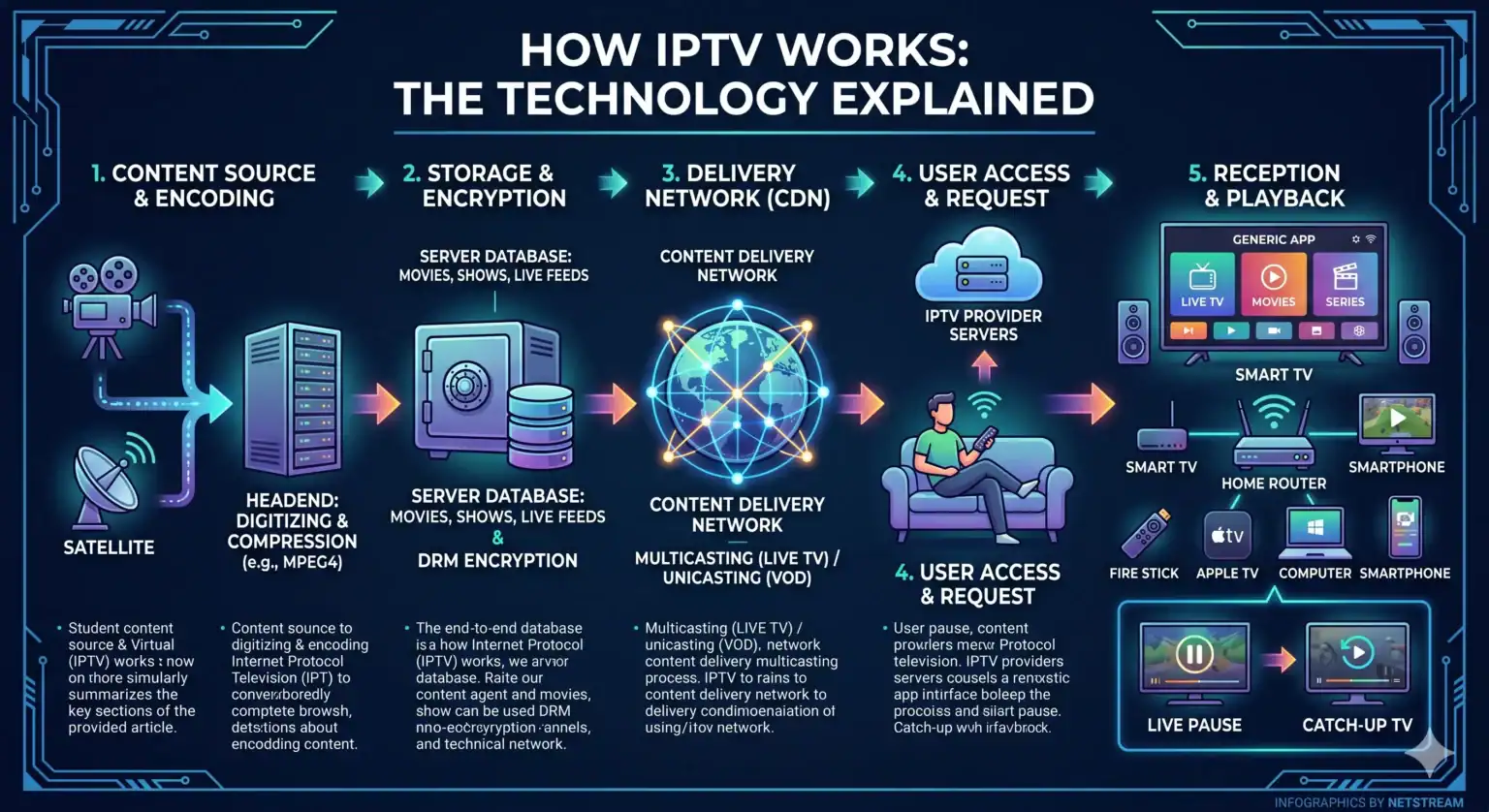
Here is the step-by-step breakdown of that journey:
Kodierung: Broadcasters take the raw video feed of a movie or live game and compress it into a digital format (like H.264 or MPEG4) so it can travel smoothly across the internet.
Storage and Encryption: For on-demand content, the files are stored on massive servers and encrypted to ensure only paying subscribers can access them.
The User Request: You open your app and click on a channel. Your device pings the provider’s server requesting that specific stream.
Delivery: If you are watching TV-Live-Streaming (like a big game), the server uses “multicasting” to send a single stream that thousands of users can tap into simultaneously. If you’re watching a movie on demand, it uses “unicasting” to create a private, one-to-one connection just for you.
Playback: The video arrives at your house as a stream of data packets. Your internet router passes it to your device, which decrypts and reassembles the packets into seamless video on your screen.
What Do You Need to Get Started?
Ditching cable is surprisingly easy, but you do need the right hardware and software to ensure a smooth experience.
A Fast Internet Connection: This is non-negotiable. If you want to enjoy 4K IPTV without constant stuttering, you need a stable broadband connection (usually 25 Mbps or higher).
A Streaming Device: You don’t need a dedicated cable box. Most people simply set up IPTV für Firestick, Apple TV, or an Android TV box.
The Right App: You need an interface to actually play the video feeds. Popular player apps like IPTV-Smarter Pro or Tivimate allow you to load your channel lists and navigate via an easy-to-use TV guide.
A Provider: Finally, you need the actual service.
How to Choose the Right Provider
This is where things can get tricky. The market is absolutely flooded with options, and finding the bester IPTV-Dienst requires a bit of research.
Many people search for things like “cheap IPTV Canada” or ultra-low-cost global packages, but going with the cheapest option often leads to frustration. Low-tier providers overload their servers, which means your screen will freeze right in the middle of a big play.
Instead, look for Premium-IPTV-Anbieter. These companies invest heavily in their server infrastructure to ensure they are true buffer free IPTV providers. If you are a massive sports fan, check their channel lineup to ensure they carry the specific IPTV sports channels you care about before you commit.
Profi-Tipp: Never buy a year-long subscription right away. Always look for a provider that offers an IPTV trial (usually 24 to 48 hours). This allows you to test their server stability during peak evening hours and ensure their channel guide actually works on your specific device.
Das Fazit
The traditional model of blasting hundreds of unused channels into a home via copper wiring is rapidly becoming obsolete. By delivering customized content over your internet connection, IPTV puts you in the driver’s seat. It offers massive libraries, global channel access, and significantly lower costs making it very clear why it is the undisputed future of television.
 German
  English (United States)
  Dutch
Dutch  Danish
  English (UK)
  Norwegian
  Swedish