
Cutting the cord used to mean stringing up a digital antenna and hoping for the best. Today, it means navigating the wild west of Internet Protocol Television (IPTV). If you are looking to slash your cable bill, you already know the market is split hard down the middle: sketchy free links on one side, and premium paid subscriptions on the other.
But does paying actually guarantee a better experience? Or are paid providers just repackaging the same exact free streams?
Here is the unfiltered breakdown of Free vs. Paid IPTV, looking at server stability, hidden risks, and what you actually get for your money.
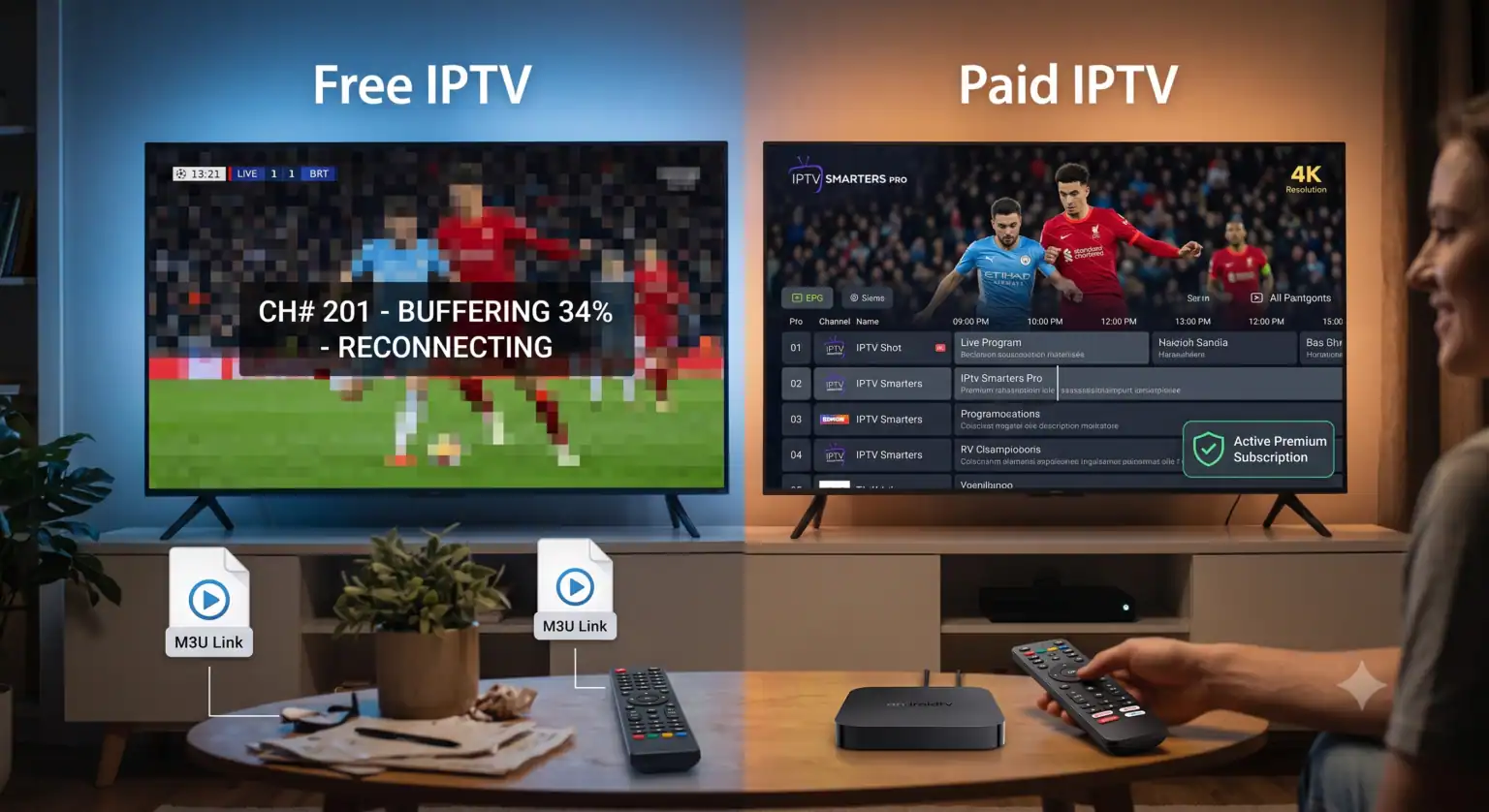
The Reality of Free IPTV
Kostenloses IPTV usually exists as M3U playlists scraped from web forums, open-source media centers, or ad-supported apps. The price tag is unbeatable, but the viewing experience requires a massive amount of patience.
The Pros:
Zero Cost: You don’t hand over your credit card, PayPal, or crypto.
Low Barrier to Entry: A quick search yields hundreds of free playlist URLs that you can instantly plug into apps like VLC or TiviMate.
The Cons (The Catch):
The Buffering Nightmare: Free servers are aggressively oversold. When a major pay-per-view fight or Premier League match kicks off, traffic spikes and the servers buckle. You will likely be staring at a pixelated, frozen screen right as the final play happens.
Dead Links: Free M3U playlists are notorious for disappearing overnight. A channel that worked flawlessly on Tuesday might be completely dead by Wednesday, forcing you back to the forums to hunt for fresh links.
Sicherheitsrisiken: Many “free” IPTV APKs (Android application packages) floating around are riddled with intrusive ads, and some actively harvest your data or inject malware into your streaming device.
Paid IPTV: Are You Getting What You Pay For?
Paid IPTV subscriptions generally run anywhere from $10 to $25 a month. When you buy into a reputable service, you aren’t just paying for content; you are paying for server infrastructure, organization, and maintenance.
The Pros:
Bare-Metal Infrastructure: Top-tier providers don’t just scrape public links. They maintain their own load-balanced servers or use advanced Content Delivery Networks (CDNs) with anti-freeze technology. This ensures smooth 4K streaming and high uptime, even during peak weekend hours.
Organized EPGs and VOD: A solid paid service comes with an accurate Electronic Program Guide (so you know what is actually playing) and a massive Video on Demand library that automatically updates with new movies and TV series.
Lightning Fast Zapping Time: Paid networks optimize their streams so that switching channels takes milliseconds, closely mirroring the traditional, seamless cable TV experience.
The Cons:
The Scam Factor: The paid IPTV market is flooded with low-quality resellers. A bad provider will happily take your money for a 12-month subscription and disappear three weeks later when their servers get shut down.
Customer Support Variances: While premium services offer dedicated Discord or Telegram support to fix dead channels on the fly, cheaper budget plans often leave you completely in the dark when things go offline.
The Key Technical Differences
| Funktion | Kostenloses IPTV | Kostenpflichtiges IPTV |
| Server Load | Overcrowded, shared public nodes. | Load-balanced, private delivery networks. |
| Stream Quality | Mostly 720p or heavily compressed 1080p. | True 1080p at 60fps and uncompressed 4K. |
| Live Sports Reliability | Very poor; streams frequently drop during big events. | Excellent; premium tiers prioritize high-traffic PPV bandwidth. |
| Maintenance | None. You are your own IT support. | Active server monitoring and daily channel updating. |
How to Navigate the Paid Market Safely
If you decide that your time is worth more than the frustration of chasing free links, tread carefully before pulling out your wallet.
Never lock into a 6-month or 12-month plan right out of the gate. Always request a 24-hour Kostenlose IPTV-Testversion. Treat this trial as a stress test. Do not just look at the channel count having 20,000 channels means absolutely nothing if they constantly buffer. Test the streams during peak evening hours. Check the zapping time between regional sports networks. If the provider refuses a short trial, or only accepts irreversible cryptocurrency payments with no money-back guarantee, walk away immediately.
Das endgültige Urteil
If you only watch television occasionally and don’t mind the technical hobby of hunting for new links every few days, Free IPTV might suffice.
However, if you want to sit down on a Sunday, fire up your Firestick or Smart TV, and instantly watch high-definition sports or movies without a second thought, Paid IPTV is the undisputed winner. You are ultimately trading a small monthly fee for stability, security, and your own sanity.
 German
  English (United States)
  Dutch
Dutch  Danish
  English (UK)
  Norwegian
  Swedish