
Is your headend ready for NextGen TV? Here is the definitive guide to bridging the gap between ATSC 3.0 IP streams and your existing MPEG-2 TS infrastructure.
The transition from ATSC 1.0 to ATSC 3.0 (NextGen TV) is the most significant architectural shift in broadcast history. It promises 4K video, immersive audio, and mobile interactivity. But for operators managing legacy IPTV og Cable systems, it brings a massive headache: Interoperability.
Unlike its predecessor, which relied on the rigid MPEG-2 Transport Stream (TS), ATSC 3.0 is the world’s first major broadcast standard built entirely on an Internet Protocol (IP) backbone.
If you are running a university campus, a hospitality video system, or a local ISP headend, your infrastructure likely speaks MPEG-2 TS. ATSC 3.0 speaks native IP. This creates a “language barrier” that breaks encapsulation, signaling, codecs, and content protection.
In this guide, we break down these friction points and outline the specific gateway technologies you need to bridge the gap between NextGen RF and legacy IP networks.
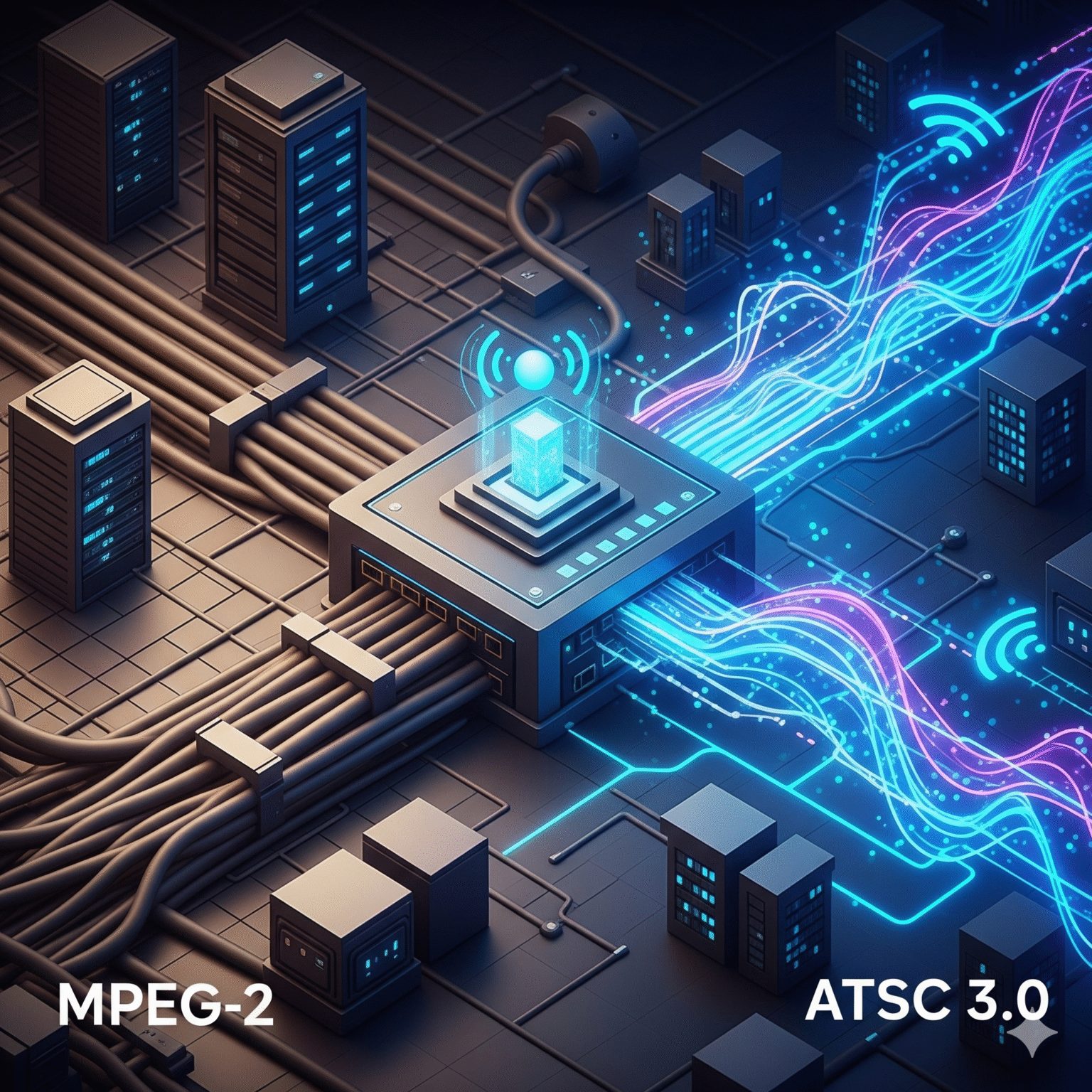
1. The Core Disconnect: IP vs. Transport Stream
For over two decades, digital television distribution has relied on one universal container: ISO/IEC 13818-1, commonly known as the MPEG-2 Transport Stream. It carried video, audio, and metadata in 188-byte packets, perfectly synced for hardware decoders.
ATSC 3.0 abandons this container.
To converge broadcast and broadband, ATSC 3.0 utilizes a pure IP stack (UDP/IP). While this allows native delivery to mobile devices and connected cars, it renders the signal “unreadable” to legacy Set-Top Boxes (STBs) designed for Multicast MPEG-2 TS.
The Technical Standoff
Funktion | Legacy IPTV Model | ATSC 3.0 Model |
|---|---|---|
Bitrate | Constant Bitrate (CBR) | Variable Bitrate (VBR) |
Container | MPEG-2 TS | IP/UDP (ROUTE/MMTP) |
Video Codec | H.264 / MPEG-2 | HEVC (H.265) |
Audio Codec | AC-3 (Dolby Digital) | Dolby AC-4 |
2. The 4 Critical Interoperability Hurdles
Connecting an ATSC 3.0 antenna to a legacy network isn’t just about demodulation. It requires complex protocol translation. Here are the four specific challenges your headend will face.
2.1 The Transport Mismatch (ROUTE/MMTP vs. TS)
This is the primary hurdle. Your legacy STBs tune to a multicast group and look for PIDs (Packet Identifiers). ATSC 3.0 delivers data as IP packets containing ROUTE sessions or MMTP packets.
The Fix: You need a gateway capable of “depacketizing” the ATSC 3.0 IP streams, extracting the media payloads, and “re-multiplexing” them into a newly generated MPEG-2 TS.
The Risk: Timing. ATSC 3.0 uses PTP/NTP for synchronization, while legacy TS relies on PCR. Your gateway must synthesize accurate PCR timestamps to prevent buffer underflows in your STBs.
2.2 Codec Incompatibility (HEVC & AC-4)
Even if you fix the container, the payload is often incompatible.
Video (HEVC): Most STBs deployed before 2018 do not support hardware HEVC decoding.
Audio (AC-4): Dolby AC-4 is a next-gen object-based codec. Virtually zero legacy STBs support it.
The Reality: Your gateway must perform real-time, high-quality transcoding (HEVC → H.264 and AC-4 → AC-3). This is computationally expensive, often forcing operators to down-convert 4K HDR signals to 1080p SDR just to get a picture on the screen.
2.3 Signaling Translation (XML to PSI/SI)
ATSC 3.0 uses XML documents (HELD, MPD, S-TSID) to describe services. Legacy STBs use binary tables (PAT, PMT, SDT).
The Mapping Problem: Your equipment must parse the XML Service Guide and dynamically generate valid DVB or ATSC 1.0 style PSI/SI tables.
Channel Mapping: Virtual channel numbers (e.g., “Channel 5.1”) in ATSC 3.0 are hidden in the Service List Table. These must be mapped to the Virtual Channel Table (VCT) in your legacy stream, or your users won’t find the channel.
2.4 Content Protection (DRM)
This is the most volatile area of the standard. ATSC 3.0 signals are increasingly encrypted using A/360 security protocols (Widevine/PlayReady).
The Workflow: To transcode, your gateway needs valid credentials to decrypt the feed.
Re-Encryption: Once decrypted and transcoded to MPEG-2, the content is “in the clear.” For a secure environment, you must re-encrypt it using your legacy CAS/DRM (e.g., Verimatrix, Pro:Idiom). This “decrypt-transcode-encrypt” chain requires strict security compliance.
3. The Solution: The ATSC 3.0 Broadcast Gateway
To solve these issues, you cannot rely on standard receivers. You need a dedicated ATSC 3.0 Broadcast Gateway.
How a Gateway Works
RF Reception: Demodulates the OFDM signal.
De-Encapsulation: Strips MMTP/ROUTE headers.
Decryption (A/360): Unlocks content using signing certificates.
Transcoding: Converts HEVC/AC-4 to H.264/AC-3 (Crucial for legacy support).
Re-Encapsulation: Wraps streams into MPEG-2 TS.
TS Output: Streams via UDP Multicast to your IPTV network.
Choosing Your Mode: Passthrough vs. Transcoding
Passthrough Mode: Ideal for networks with modern Smart TVs running ATSC 3.0 apps. It routes native IP streams, preserving 4K and HDR.
Transcoding Mode: The necessary choice for hospitality, hospitals, and legacy cable. It is the “lowest common denominator” approach but ensures reliability across aging screens.
4. Future Outlook: The Move to All-IP
The interoperability gap is significant, but it is bridgeable. For the next 3-7 years, transcoding gateways will be the essential “universal translators” of the broadcast world.
However, the long-term trend is clear. As legacy set-top boxes age out, operators will replace them with Android TV or RDK devices capable of decoding HEVC and AC-4 natively. This will eventually eliminate the need for heavy transcoding, allowing the ATSC 3.0 IP streams to pass directly to the “glass,” finally realizing the promise of broadcast-broadband convergence.
Need help architecting your ATSC 3.0 headend? Understanding the nuances of A/331 and A/360 is critical to avoiding black screens. Ensure your infrastructure is ready for the switch.
 Danish
  English (United States)
  German
  Dutch
Dutch  Swedish
  English (UK)
  English (Australia)
  English (New Zealand)
  Norwegian