
As television technology evolves, IPTV TV is rapidly replacing traditional TV systems such as cable and satellite. While most users notice better picture quality and more flexibility, the real transformation happens behind the scenes. The key difference lies in middleware technology.
This article explains the middleware differences between IPTV TV and traditional TV, using clear comparisons, strong keyword focus, and practical insights for modern Smart TV users.
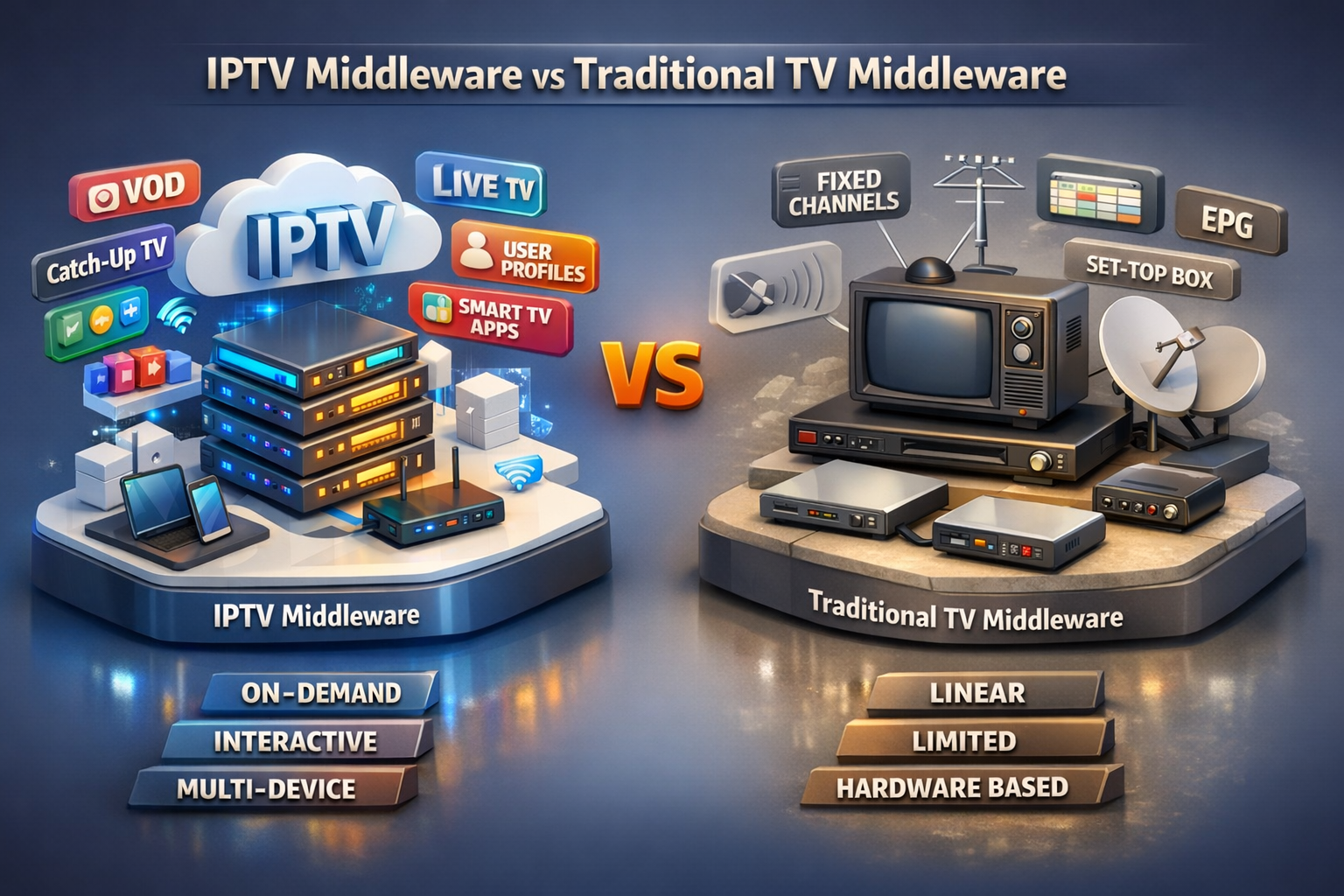
What Is Middleware in TV Systems?
TV middleware is the software layer that connects the TV hardware with content, applications, and user interfaces. It manages how channels load, how menus work, and how interactive features respond.
Without middleware:
IPTV would not support on-demand content
Smart TVs would lack interactive menus
Traditional TV would be limited to fixed channels only
Understanding middleware helps explain why IPTV TV is more advanced than traditional TV.
Traditional TV Middleware Explained
Traditional TV middleware was designed for one-way broadcasting. Cable and satellite providers push content to viewers with minimal interaction.
Key Characteristics of Traditional TV Middleware
Static channel lists
Limited electronic program guide (EPG)
No real personalization
No cloud integration
Hardware-dependent systems
Traditional middleware focuses on signal decoding, not user experience. Updates are slow, and features remain fixed for years.
Limitations of Traditional TV Systems
No real-time interactivity
No multi-device support
No on-demand control
Minimal customization
This makes traditional TV less flexible in the age of Smart TVs and streaming.
IPTV TV Middleware Explained
IPTV middleware is built for internet-based delivery and interactive services. It acts as a central brain that manages content, users, devices, and apps.
Core Functions of IPTV Middleware
Content delivery over IP networks
Interactive menus and Smart TV interfaces
User authentication and profiles
On-demand streaming and live TV
Multi-device synchronization
IPTV middleware transforms TV into a software-driven experience, similar to modern streaming platforms.
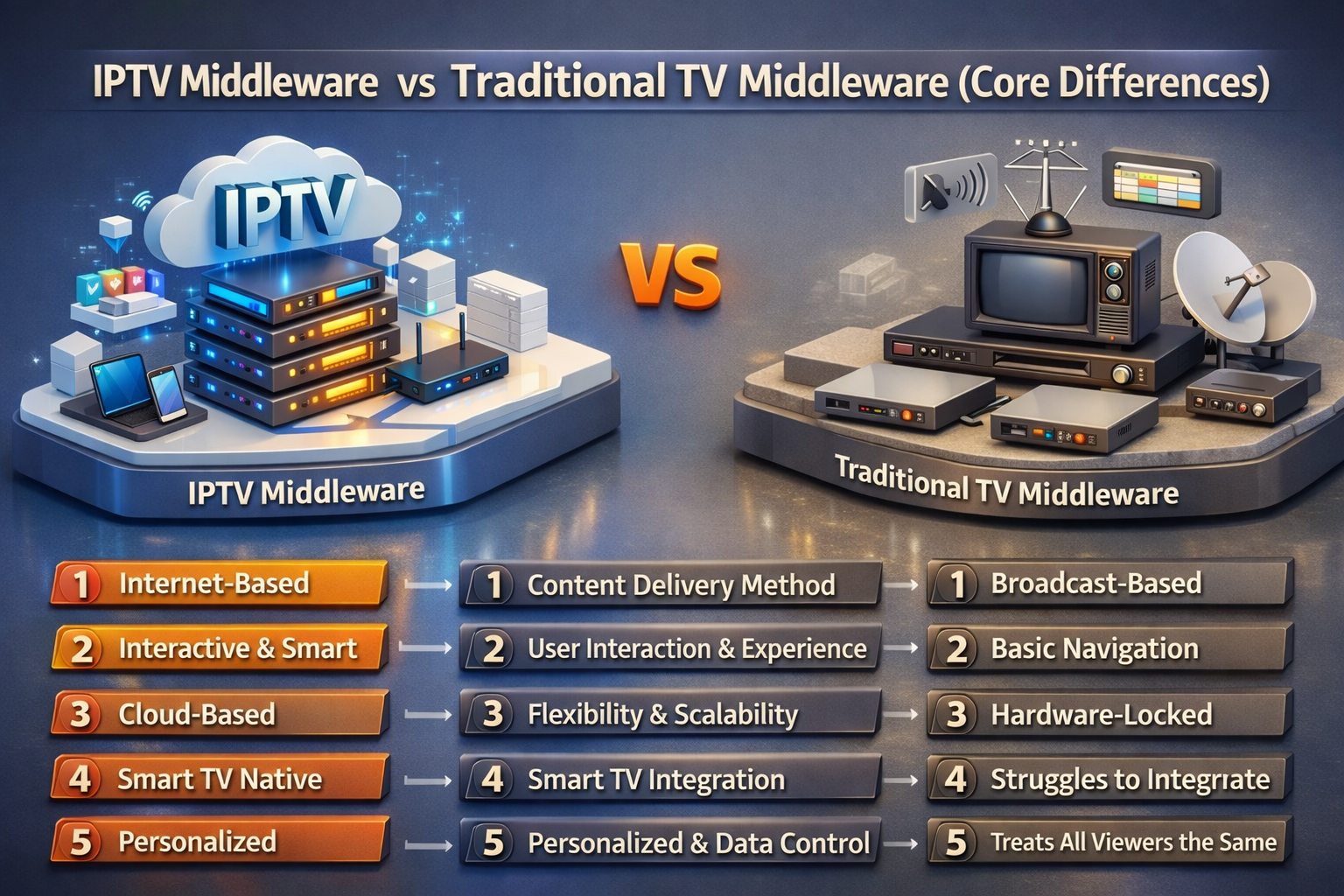
IPTV Middleware vs Traditional TV Middleware (Core Differences)
1. Content Delivery Method
Traditional TV: Broadcast-based (one-way signal)
IPTV TV: Internet-based (two-way communication)
IPTV middleware enables real-time interaction, while traditional middleware does not.
2. User Interaction & Experience
Traditional TV offers basic navigation
IPTV TV supports:
Catch-up TV
Video on demand (VOD)
Interactive menus
Personalized recommendations
This is why IPTV feels faster, smarter, and more modern.
3. Flexibility & Scalability
Traditional middleware is hardware-locked
IPTV middleware is cloud-based and scalable
New features can be added remotely without changing the TV hardware.
4. Smart TV Integration
IPTV middleware is designed specifically for:
Traditional TV middleware struggles to integrate with modern Smart TV platforms.
5. Personalization & Data Control
IPTV middleware allows:
User profiles
Viewing history
Content suggestions
Multi-language interfaces
Traditional TV middleware treats all viewers the same.
Why IPTV Middleware Is the Future of Television
The shift from traditional TV to IPTV TV is driven by software innovation. IPTV middleware enables:
Faster updates
Better user experience
Advanced analytics
Interactive advertising
Cross-device streaming
As Smart TVs become more powerful, middleware-driven IPTV systems dominate the market.
IPTV TV vs Traditional TV: Final Comparison
| Feature | Traditional TV | IPTV TV |
|---|---|---|
| Middleware Type | Static | Dynamic & Cloud-based |
| Interactivity | Very Limited | Advanced |
| Personalization | None | Full |
| Smart TV Support | Weak | Native |
| On-Demand Content | No | Yes |
| Updates | Rare | Frequent |
Final Thoughts
The real difference between IPTV TV and traditional TV is not just content it is middleware technology. IPTV middleware enables interactivity, personalization, and flexibility that traditional TV systems cannot match.
For users seeking modern Smart TV experiences, IPTV TV powered by advanced middleware is clearly the superior choice in 2026 and beyond.
 English (New Zealand)
  English (United States)
  German
  Dutch
Dutch  Swedish
  Danish
  English (UK)
  English (Australia)
  Norwegian