
Stop wasting bandwidth. Video traffic now accounts for over 65% of the entire internet’s data load. If you are a streaming platform, a broadcaster, or a tech-savvy consumer, your choice of codec H.265 (HEVC) or AV1 directly impacts your server costs, buffering times, and visual fidelity.
As resolutions climb to 8K, the industry has split into two camps. This definitive guide breaks down the H.265 vs. AV1 battle, analyzing technical performance, licensing costs, and which standard you should bet on in 2026.
Quick Verdict: The 30-Second Summary
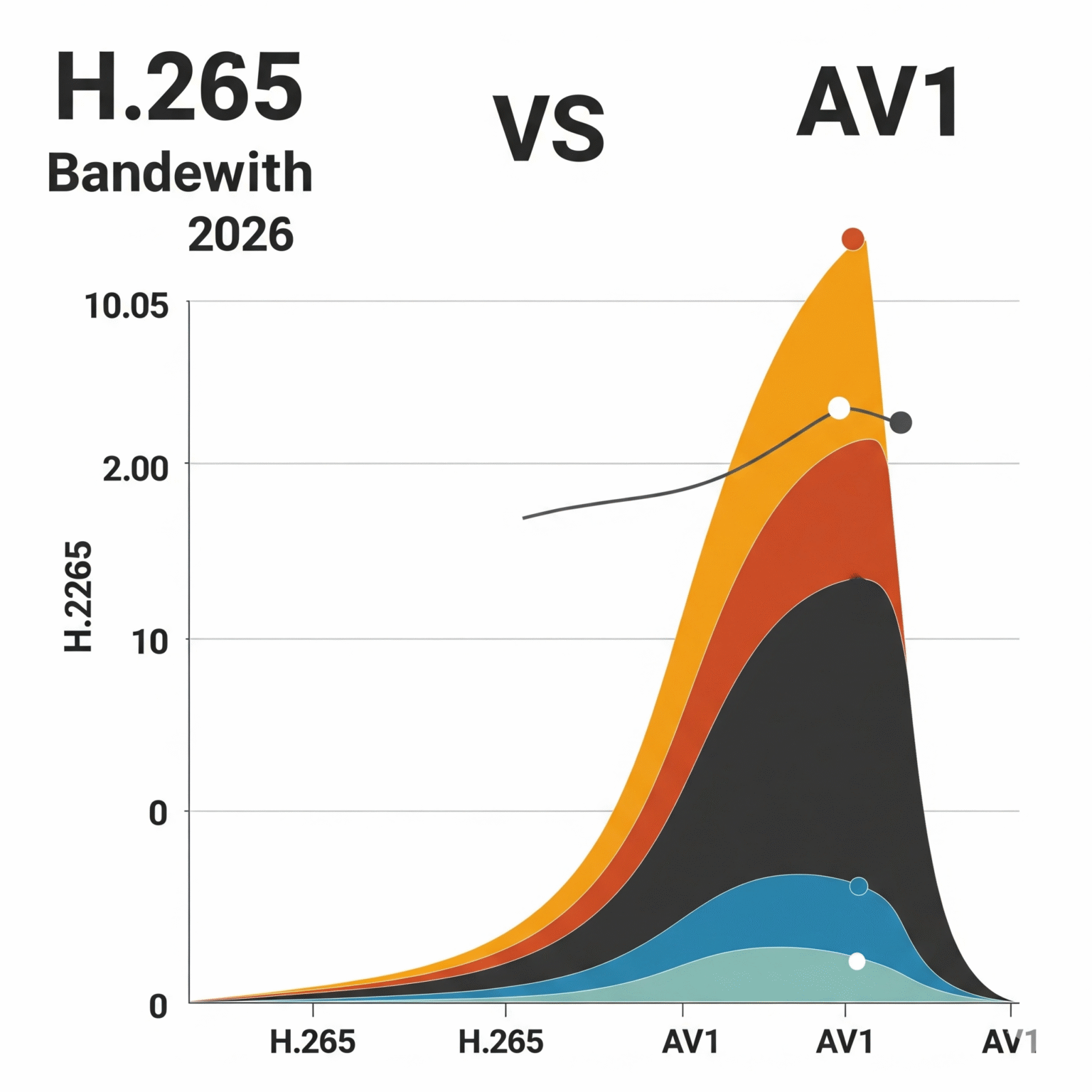
1. The Technical Face-Off: H.265 vs. AV1 Efficiency
The primary metric for any next-gen codec is compression efficiency delivering higher quality video at lower bitrates.
Feature | H.265 (HEVC) | AV1 (AOMedia Video 1) |
|---|---|---|
Compression Power | ~50% better than H.264 | ~30% better than H.265 |
Bitrate Savings | High | Ultra-High (30-50% savings) |
Best Application | Live Broadcast, Hardware Recording, iOS | Netflix, YouTube, Web Streaming |
Licensing Cost | High (Royalty-bearing) | $0 (Royalty-Free) |
Encoding Speed | Fast (Mature hardware) | Slower (Demands modern CPU/GPU) |
Playback Impact | Low battery drain (Universal) | High battery drain (software decode) |
Why AV1 is the Efficiency King
In head-to-head benchmarks, AV1 consistently outperforms H.265. It allows platforms to stream 4K HDR content at bitrates that used to struggle with 1080p.
The “Netflix Effect”: For streaming giants, switching to AV1 saves millions in Content Delivery Network (CDN) fees.
User Benefit: Viewers on limited cellular plans can watch high-definition streams without hitting data caps or suffering buffering loops.
2. The Economic Factor: Why "Free" is Winning
Technology doesn’t exist in a vacuum. The biggest differentiator between these two standards is their business model.
H.265 (HEVC): The Licensing Nightmare
H.265 is technically brilliant but legally messy. It is bogged down by a complex patent pool structure involving MPEG-LA, HEVC Advance, and Velos Media.
The Cost: Content owners and hardware makers often pay royalties per device or stream. This “royalty tax” is why browsers like Chrome and Firefox resisted adopting H.265 for years.
The Niche: Despite the cost, HEVC dominates Broadcast TV (ATSC 3.0) and physical media because it was the only viable 4K option when those standards were written.
AV1: The Open Source Revolution
Developed by the Alliance for Open Media (Google, Netflix, Apple, Microsoft), AV1 was built to break the patent deadlock.
The Advantage: It is royalty-free. Platforms like YouTube can scale their bandwidth usage infinitely without owing a cent in licensing fees. This economic freedom is the primary engine driving AV1’s rapid adoption.
3. The Compatibility Reality Check
While AV1 wins on paper, H.265 still wins in your living room. Hardware compatibility is the single biggest bottleneck for mass AV1 adoption.
The “Battery Drain” Issue
Codecs need hardware acceleration to run efficiently.
H.265: Almost every smartphone, TV, and PC made after 2015 has a dedicated H.265 chip. It plays smoothly without heating up your device.
AV1: If a device lacks an AV1 decoder, it forces the CPU to do the heavy lifting (software decoding). This kills battery life—draining power 50-100% faster than H.265.
Does Your Device Support AV1?
✅ Safe Zone: Devices with Snapdragon 8 Gen 2, Apple A17 Pro (iPhone 15 Pro), NVIDIA RTX 30/40 series, and Intel 11th Gen+.
❌ Danger Zone: Most budget Android phones, older iPhones, and Smart TVs purchased before 2023.
4. Final Verdict: H.265 or AV1?
The war has settled into a pragmatic truce.
Winner: AV1 (The Streaming King)
If you are a web developer, a YouTuber, or running a VOD platform, AV1 is mandatory.
Why: The bandwidth savings are too massive to ignore.
Adoption: Over 70% of Netflix’s library and a massive portion of YouTube is now AV1.
Winner: H.265 (The Production Standard)
If you are a videographer, editor, or broadcaster, H.265 is your workhorse.
Why: Cameras (Sony, Canon, DJI) record in H.265 because the encoders are fast and power-efficient. Broadcast infrastructure is built on it.
The Future: H.266 (VVC)
Looking ahead? H.266 (VVC) promises another 50% efficiency jump. But with consumer hardware support virtually non-existent in 2026, AV1 remains the champion of the here and now.
 English (New Zealand)
  English (United States)
  German
  Dutch
Dutch  Swedish
  Danish
  English (UK)
  English (Australia)
  Norwegian