
As global demand for IPTV, OTT platforms, 4K/8K streaming, live sports, and low-latency video continues to surge, video codecs have become a core ranking factor for streaming performance, operational costs, and user experience.
Choosing the right codec is no longer a technical afterthought it is a strategic business decision that directly impacts bandwidth efficiency, CDN expenses, device compatibility, and long-term scalability.
This guide explains how video codecs evolved, compares H.264, H.265 (HEVC), AV1, and VVC (H.266), and clearly answers the key question:
👉 Which codec should operators choose in 2026 and beyond?
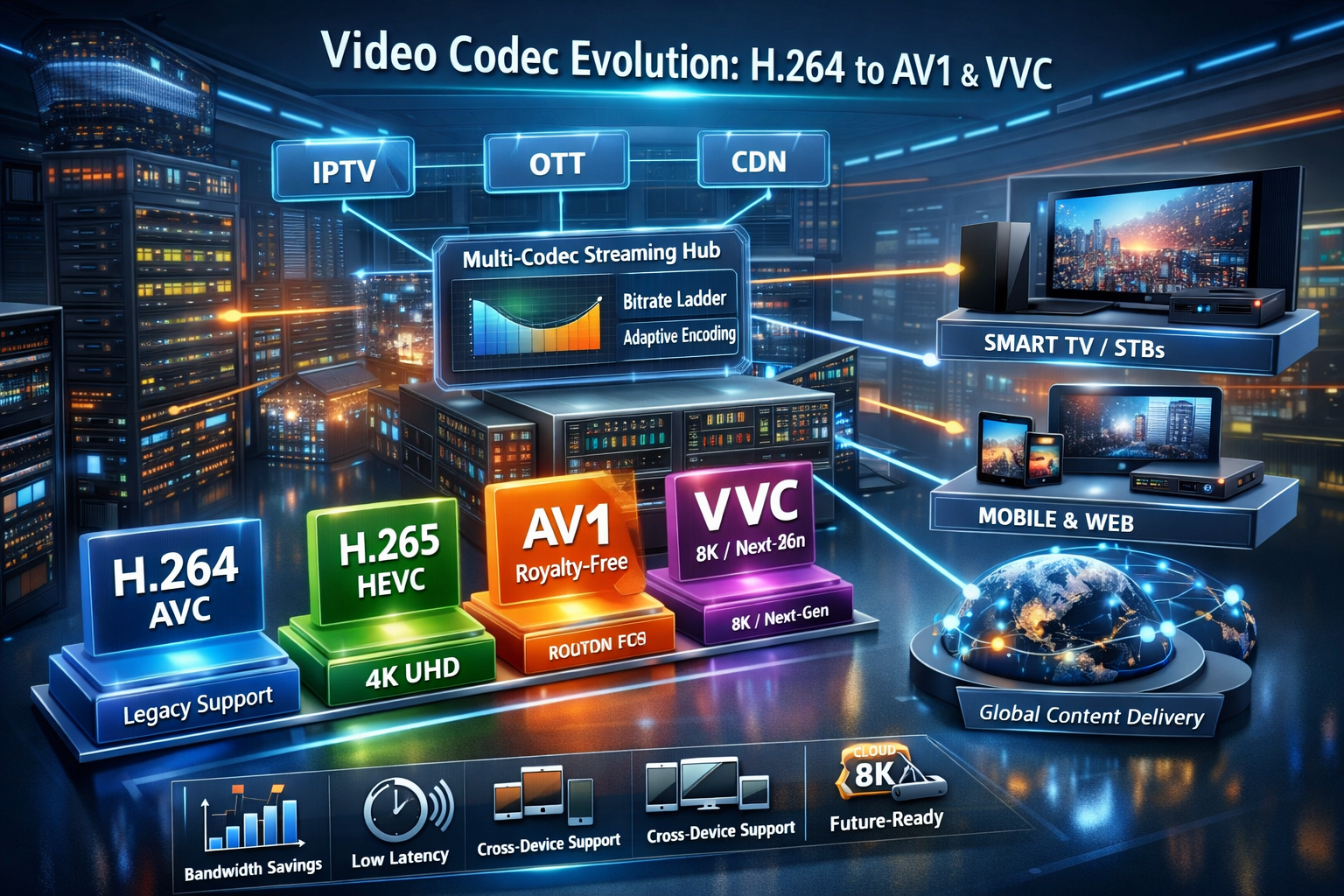
Why Video Codecs Are Critical for Modern Streaming Platforms
In 2026, streaming providers must deliver:
Ultra-HD quality (4K & 8K)
Zero-buffer, low-latency live streams
Stable playback on mobile, Smart TVs, and browsers
Optimized delivery over limited bandwidth
Lower infrastructure and CDN costs
Advanced codecs can reduce data usage by up to 50%, allowing operators to scale faster while improving viewer satisfaction metrics such as watch time and bounce rate.
H.264 (AVC): Maximum Compatibility, Minimum Efficiency
H.264 remains the most widely used video codec in the world due to its universal support across devices and platforms.
Key Advantages
Works on virtually all devices and operating systems
Ideal for SD, HD, and legacy environments
Low CPU and hardware requirements
Stable and predictable encoding performance
Major Limitations
Inefficient for 4K, HDR, and high frame rates
Higher bandwidth consumption
Limited future scalability
Best suited for: Legacy IPTV systems, older devices, and fallback streams.
H.265 (HEVC): Optimized for UHD IPTV Delivery
H.265 was designed to significantly improve compression efficiency over H.264, especially for 4K and HDR video.
Strengths
Around 40% bandwidth savings vs H.264
Excellent visual quality at lower bitrates
Strong hardware support on Smart TVs and set-top boxes
Weaknesses
Licensing and patent fees
Limited browser-level support
Higher encoding complexity
AV1: The Best Codec for Cost-Efficient, Future-Ready Streaming
AV1 has emerged as the most important next-generation codec for modern streaming ecosystems.
Why AV1 Is a Breakthrough
Up to 50% better compression than H.264
Royalty-free (no licensing costs)
Excellent performance at low bitrates
Rapidly expanding hardware and browser support
Current Challenges
Higher encoding CPU requirements
Hardware decoding still rolling out (but accelerating fast)
VVC (H.266): The Future of Ultra-High-Efficiency Video Compression
VVC represents the cutting edge of video compression, built for 8K, VR, AR, and immersive media experiences.
Benefits
Around 50% more efficient than H.265
Designed for next-generation video formats
Ideal for future-proof infrastructures
Limitations
Very high computational demands
Complex licensing model
Limited commercial deployment (as of 2026)
Codec Comparison Table (Operator-Focused)
| Codec | Compression Efficiency | Licensing | Device Support | Scalability |
|---|---|---|---|---|
| H.264 | Moderate | Licensed | Excellent | Low |
| H.265 | High | Licensed | Strong (TVs) | Medium |
| AV1 | Very High | Free | Rapidly Growing | Very High |
| VVC | Extreme | Licensed | Limited | Exceptional |
What Codec Should Operators Choose in 2026?
Best Overall Strategy: AV1 + H.264 Hybrid
AV1 for modern browsers, mobile, and Smart TVs
H.264 as a universal fallback
Lower bandwidth costs + full compatibility
Best for IPTV & Smart TV Networks
H.265 remains reliable for UHD channels
Hardware decoding already deployed at scale
Future-Proof Planning
Begin testing VVC selectively
Prepare infrastructure for next-gen codecs
Best Practices for Streaming Operators
Deploy multi-codec encoding pipelines
Use adaptive bitrate streaming (ABR)
Optimize streams for CDN and edge delivery
Match codec strategy to target markets and devices
Favor royalty-free codecs to control long-term costs
Final Takeaway
The transition from H.264 to AV1 and VVC is reshaping the entire streaming industry. While legacy codecs still play a role, AV1 is the smartest choice for most operators in 2026, delivering unmatched efficiency, cost savings, and future readiness.
 English (United States)
  German
  Dutch
Dutch  Swedish
  Danish
  English (UK)
  English (Australia)
  English (New Zealand)
  Norwegian